
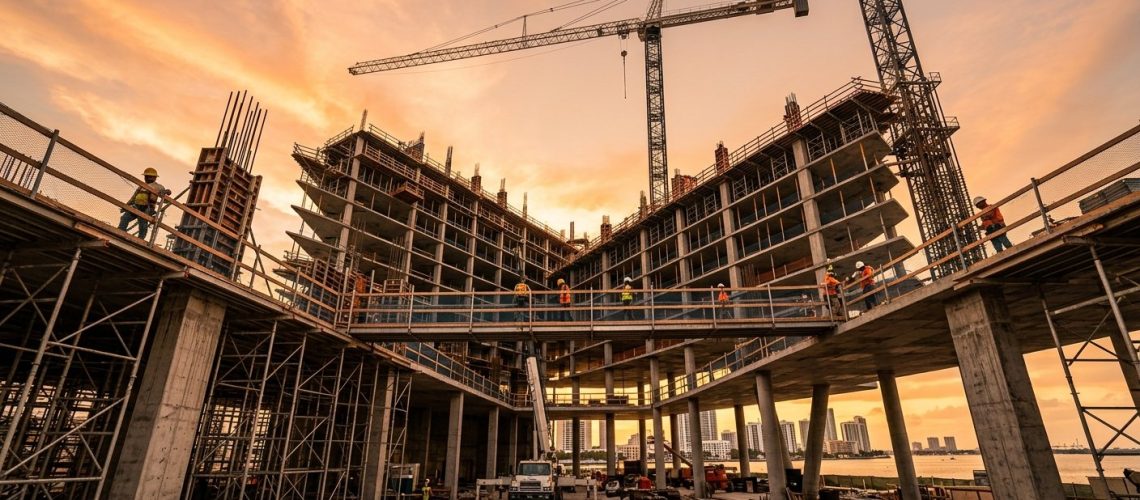
From groundbreaking to grand opening, a hotel development project in South Florida is one of the most complex construction undertakings a developer can pursue. If you’ve ever wondered why your neighbor’s boutique hotel took three years to open while another property nearby seemed to materialize in eighteen months, you’re not alone. Timelines vary dramatically—and for good reason.
Understanding what drives hotel construction schedules in Miami-Dade, Broward, and Palm Beach Counties helps developers plan smarter, budget more accurately, and choose construction partners who know how to keep projects moving. Here’s what every South Florida developer and property owner should know before breaking ground.
What’s the Typical Timeline for Hotel Construction?
In South Florida, a new hotel development generally follows a phased process that spans anywhere from 18 months to four-plus years, depending on project size, complexity, and site conditions. Most mid-scale hotel projects with 100–200 keys typically land in the 24–36 month range from permit approval to completion. Larger, full-service or mixed-use hospitality properties can extend well beyond that.
Here’s a general framework for how those timelines break down:
- Pre-Construction & Design Phase: 6–18 months
- Permitting & Approvals: 3–12 months (varies by municipality)
- Site Preparation & Foundation: 2–4 months
- Structural & Core Construction: 6–18 months
- MEP Rough-In & Interior Buildout: 4–8 months
- FF&E Installation & Final Inspections: 2–4 months
Every phase is interdependent. A delay in permitting cascades into structural scheduling conflicts. A supply chain hiccup during MEP rough-in can push FF&E installation back by months. This is why experienced hospitality construction management isn’t just about building—it’s about orchestrating dozens of moving parts with foresight and discipline.
Why South Florida Is Uniquely Challenging
Developing hotels in South Florida isn’t like building anywhere else. The region’s regulatory environment, environmental sensitivity, high water table, and coastal zoning rules create a layered approval process that demands local expertise to navigate efficiently.
Permitting in Miami-Dade, Broward, and Palm Beach
Each county and municipality has its own building department, review timelines, and code requirements. A project in the City of Miami may face different design review boards than one in Boca Raton or Fort Lauderdale. Coastal construction projects often require additional sign-off from the Florida Department of Environmental Protection, particularly if they fall within coastal setback zones. According to the Florida Building Commission, the Florida Building Code has unique coastal and wind-load requirements that significantly influence structural design decisions for high-rise hospitality projects.
Developers who underestimate the permitting phase often find themselves stalled for six months or more before a single shovel hits the ground. Working with a general contractor who has deep relationships with local jurisdictions—and who has successfully navigated these reviews many times before—can meaningfully compress this window.
Soil Conditions and the High Water Table
South Florida’s limestone bedrock and shallow water table create foundation challenges that are unique to the region. Pile driving, dewatering systems, and specialized foundation designs add both time and cost that developers must account for early. These aren’t surprises to a seasoned local team—they’re expected variables that good pre-construction planning addresses head-on.
Hurricane Resilience Requirements
Building to Florida’s wind codes isn’t optional, and it shapes both design timelines and construction schedules. From impact-resistant glazing to reinforced structural systems, hospitality projects must meet stringent requirements that reflect the region’s real risk exposure. The Federal Emergency Management Agency has long documented the importance of resilient construction in hurricane-prone coastal markets—and South Florida developers who build to these standards protect both their investment and future guests.
The Pre-Construction Phase: Where Timelines Are Won or Lost
Most timeline problems don’t begin during construction—they begin months earlier when pre-construction planning is rushed or skipped. This is the phase where a hospitality construction contractor earns their keep.
Strong pre-construction services for South Florida hotel projects include:
- Site feasibility analysis and geotechnical review
- Constructability reviews of architectural and engineering drawings
- Early trade partner engagement and subcontractor bidding
- Detailed scheduling with milestone accountability
- Value engineering to optimize costs without compromising design intent
- Long-lead procurement for elevators, HVAC equipment, and specialty finishes
At Ortega’s Building & Construction, pre-construction is treated as a partnership with developers and architects—not a formality. With more than 10 years of hands-on South Florida construction experience, our team has seen what happens when these steps are skipped. The cost is always greater than the time saved.
Construction Management: The Engine Behind On-Time Delivery
For hotel development in South Florida, strong commercial construction management isn’t a luxury—it’s a requirement. The hospitality sector demands precision because a hotel opening is a brand moment. Pre-sold rooms, franchise deadlines, and staff onboarding schedules all hang on the construction timeline.
Trade Coordination
A typical mid-scale hotel involves 20 or more specialty subcontractors working across mechanical, electrical, plumbing, fire suppression, technology systems, millwork, and finishes. Coordinating these trades—especially in occupied or phased construction environments—requires daily oversight and a project leadership team that communicates with transparency.
Owner Communication and Transparency
Developers deserve to know exactly where their project stands at any given moment. The best hospitality construction contractors don’t wait for owners to ask questions—they proactively communicate progress, flag emerging risks, and present solutions before problems become delays. This is what a stakeholder mentality looks like in practice.
Phased Openings
For larger hotel projects with multiple room blocks or amenity phases, a phased opening strategy can be a powerful tool. Opening one wing or floor ahead of schedule while completing secondary amenities allows developers to begin generating revenue sooner. This approach requires meticulous planning during pre-construction—but when executed well, it protects the developer’s investment timeline significantly.
How to Choose the Right Hotel Construction Partner
The contractor relationship in a hospitality project isn’t transactional—it’s foundational. Developers who treat their general contractor as a true partner from day one tend to experience fewer surprises, more efficient problem-solving, and better project outcomes overall.
When evaluating hotel development contractors in South Florida, consider:
- Local experience: Does the team know Miami-Dade, Broward, and Palm Beach jurisdictions firsthand?
- Hospitality portfolio: Have they delivered comparable hotel or mixed-use projects at your scale?
- Trade network: Do they maintain strong relationships with reliable local subcontractors?
- Communication style: Are they proactive and transparent, or reactive and hard to reach?
- Licensed and insured: Non-negotiable for any South Florida commercial build.
- Owner alignment: Do they think like a partner, or just a vendor?
These aren’t just nice-to-haves. In South Florida’s fast-moving development market, the wrong general contractor can cost a developer months—and the relationship damage that follows is hard to repair.
Frequently Asked Questions
How long does it take to build a hotel in South Florida?
Most mid-scale hotel projects in Miami-Dade, Broward, and Palm Beach Counties take between 24 and 36 months from permit approval to completion. Larger, full-service, or mixed-use hospitality properties can take three to four or more years, depending on scope, site conditions, and regulatory complexity.
What causes hotel construction delays in South Florida?
Common causes include extended permitting timelines, supply chain disruptions for long-lead materials, subcontractor scheduling conflicts, site conditions like high water tables or soil variability, and incomplete or changing design documentation. Strong pre-construction planning and an experienced local general contractor significantly reduce these risks.
What is hospitality construction management?
Hospitality construction management refers to the professional oversight and coordination of all construction activities for hotel and resort projects. This includes pre-construction planning, trade coordination, schedule management, budget control, quality assurance, and owner communication from groundbreaking through final certificate of occupancy.
Do I need a general contractor who specializes in hotels?
Yes. Hotel construction involves unique systems—commercial kitchens, pool areas, elevator banks, technology infrastructure, branded design standards, and phased guest experience elements—that require specific expertise. A general contractor with proven hospitality project experience in South Florida will navigate these requirements more efficiently and with fewer costly surprises.
What permits are needed for hotel construction in South Florida?
Hotel projects typically require building permits, zoning approvals, fire protection reviews, health department approvals for food service or pool facilities, and in coastal areas, environmental permits from state agencies. Requirements vary by county and municipality, which is why working with a contractor who has existing relationships with local building departments is a meaningful advantage.
Building Hotels That Last for Generations
At Ortega’s Building & Construction, we approach every hotel construction project in South Florida the same way we approach every relationship—with integrity, attention, and a genuine investment in the outcome. Our team serves developers, property owners, and architects across Boca Raton, Miami, Fort Lauderdale, and West Palm Beach, bringing local knowledge and a family legacy that spans generations in this market.
We understand that for our clients, a hotel isn’t just a building—it’s a vision, a business, and a legacy. That’s exactly the kind of work we show up for every day.
If you’re planning a hospitality development in South Florida and want to talk through your timeline, scope, or project vision, we’d love to connect. Reach out to the Ortega’s team today and let’s start building something that matters.