
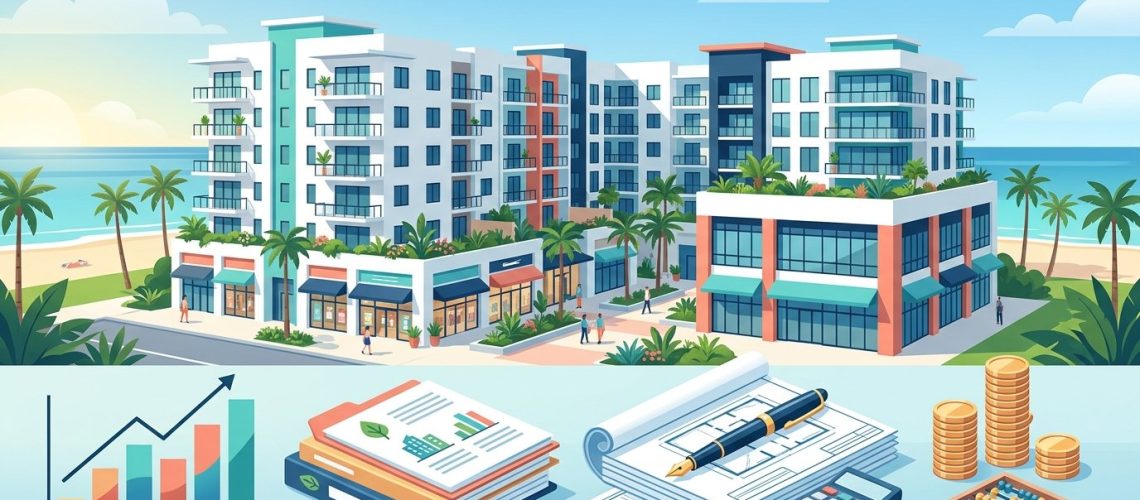
Mixed-use development is booming across South Florida. From live-work-play communities in Boca Raton to transit-oriented developments near Fort Lauderdale’s urban core, developers are recognizing the long-term value of blending residential, retail, and commercial uses under one roof. But budgeting these projects? That’s where complexity lives.
Unlike single-use buildings, mixed-use projects carry layered costs that shift depending on the unit mix, regulatory environment, site conditions, and phasing strategy. Miss something early, and you’re scrambling for contingency funds mid-construction. Get it right from the beginning, and you create a project that performs financially and serves the community for decades.
At Ortega’s Building & Construction, we’ve worked alongside developers, architects, and property owners across Miami-Dade, Broward, and Palm Beach Counties to navigate exactly these challenges. Here’s a practical, honest framework for budgeting your next mixed-use development in South Florida.
Start With a Clear Project Definition
Before a single number goes into a spreadsheet, you need clarity on what you’re actually building. The scope of your mixed-use project determines everything downstream — from structural systems to permitting fees to construction timelines.
Ask yourself:
- What’s the ratio of residential to commercial square footage?
- Will ground-floor retail require separate HVAC, egress, and utility metering?
- Are you incorporating hospitality components like short-term rentals or a hotel?
- What’s the parking strategy — structured, surface, or podium?
- What amenity programming are you targeting?
Each of these decisions carries hard cost implications. A podium parking structure, for example, can add $25,000–$45,000 per space depending on the design. Defining these variables before engaging a general contractor saves time, money, and avoids costly redesigns.
Understand the South Florida Cost Environment
South Florida’s construction market has its own dynamics. Labor markets in Miami-Dade, Broward, and Palm Beach Counties remain competitive, materials pricing continues to fluctuate, and the region’s building codes — shaped by hurricane resilience requirements — add costs that developers in other markets simply don’t face.
According to the U.S. Bureau of Labor Statistics Southeast Regional Office, construction employment in Florida has remained consistently elevated, keeping skilled trade labor in high demand. That demand drives wages and subcontractor pricing upward — a reality that must be baked into your budget from day one.
Florida Building Code requirements — particularly wind load compliance and flood elevation standards — also add layers of cost that aren’t negotiable. Working with experienced South Florida construction management services means those requirements are anticipated, priced accurately, and never treated as surprises.
The Six Core Budget Categories for Mixed-Use
1. Hard Costs (Construction)
Hard costs are the bricks-and-mortar expenses — the physical construction of the building. For mixed-use projects in South Florida, hard costs typically include:
- Site work and foundation (impacted by soil conditions and elevation)
- Structural framing (concrete, steel, or a combination)
- Exterior envelope — roofing, windows, façade systems
- MEP systems (mechanical, electrical, plumbing) — often more complex in mixed-use
- Interior finishes for both residential and commercial components
- Vertical transportation (elevators for multi-story developments)
Mixed-use projects carry higher MEP complexity because residential and commercial spaces often require entirely separate systems. Budget accordingly and don’t assume residential unit costs will carry over to retail or amenity spaces.
2. Soft Costs (Pre- and Post-Construction)
Soft costs are frequently underestimated, especially by first-time developers. These include architecture and engineering fees, permitting and impact fees, environmental assessments, surveys, legal and title work, financing costs, and developer overhead. In South Florida, municipal impact fees alone can be significant — particularly in growing markets like West Palm Beach and Doral where city infrastructure investments are ongoing.
3. Land and Site Acquisition
Your land cost sets the floor for everything else. In a high-value urban market like Miami or Fort Lauderdale, land pricing can represent 15–30% of total project cost. Factor in entitlement timelines as well — zoning approvals, variance hearings, and public comment processes in South Florida municipalities can add months to your pre-construction calendar.
4. Contingency Budget
A responsible mixed-use budget always includes contingency — typically 5–10% of hard costs during design development, and 3–5% during construction. South Florida’s conditions — from unexpected soil conditions to hurricane season disruptions — make contingency not just standard practice but essential protection.
5. Financing and Carrying Costs
Construction loan interest, lender fees, and carrying costs during lease-up are real line items. In today’s rate environment, these can represent a meaningful percentage of total project cost. Work with your lender and your construction management partner to establish a draw schedule that minimizes carrying time without compromising quality or safety.
6. FF&E and Tenant Improvement Allowances
If your ground-floor retail is being delivered to commercial tenants, negotiate TI allowances carefully. Hospitality components like hotel lobbies or short-term rental amenities will carry FF&E (furniture, fixtures, and equipment) budgets that are entirely separate from base construction. Our team at Ortega’s often helps clients think through these numbers during preconstruction — it’s one of the most valuable early conversations we have.
Phasing Strategy and Its Budget Impact
Many South Florida mixed-use projects are built in phases, and phasing decisions have direct budget consequences. Building residential towers before retail podiums, for example, can allow early revenue generation but may require temporary infrastructure that gets replaced later — an added cost. Conversely, delivering all phases simultaneously increases construction risk and requires more intensive commercial construction management oversight.
There’s no universal right answer. The best phasing strategy depends on your financing structure, market absorption projections, and site logistics. A trusted general contractor who’s navigated South Florida’s mixed-use market brings real value here — not just building what’s designed, but helping you think through what sequence makes the most sense financially.
Common Budgeting Mistakes to Avoid
After working across projects in Miami, Fort Lauderdale, Boca Raton, and West Palm Beach, we see developers make similar budgeting mistakes that are entirely avoidable:
- Underestimating permitting timelines. South Florida municipalities have varying review cycles. A delayed permit means extended carrying costs and delayed revenue.
- Using out-of-market cost benchmarks. National or even statewide data doesn’t reflect South Florida’s labor and material realities. Use local data and local expertise.
- Failing to align the design team and GC early. When architects design in a vacuum and contractors price after the fact, value engineering at the end of design becomes expensive and disruptive. Preconstruction collaboration solves this.
- Underbudgeting MEP for mixed-use complexity. Separate systems for commercial and residential components cost more. Budget for it from the start.
- Ignoring insurance and bonding costs. Licensed and insured contractors carry appropriate coverage, and those costs are part of the project. Make sure your budget reflects realistic subcontractor insurance requirements.
The Value of Preconstruction Partnership
One of the most important investments a mixed-use developer can make is engaging a construction management partner early — during design development, not just when you’re ready to break ground. Preconstruction services, including budget modeling, constructability reviews, and subcontractor early engagement, can meaningfully reduce risk and improve budget accuracy.
The Associated General Contractors of America consistently highlights preconstruction collaboration as one of the primary drivers of on-time, on-budget project delivery. It’s not just theory — it’s what we practice every day across our South Florida projects.
With more than 10 years of hands-on South Florida construction experience, our team understands that a well-budgeted project isn’t just about numbers on a spreadsheet. It’s about protecting your investment, respecting your stakeholders, and building something the community will value for generations.
Frequently Asked Questions
What is a realistic cost per square foot for mixed-use construction in South Florida?
Mixed-use construction in South Florida typically ranges from $175 to $350+ per square foot for hard costs, depending on the project type, finish level, structural system, and location. Urban infill sites in Miami or Fort Lauderdale tend to run higher due to site logistics and labor costs. Always establish your budget with a local general contractor using current, market-specific data.
How much contingency should I budget for a mixed-use project?
During design development, budget 7–10% contingency on hard costs. Once construction documents are complete and a GMP (Guaranteed Maximum Price) contract is in place, a 3–5% construction contingency is standard. South Florida’s hurricane season and supply chain variability make maintaining adequate contingency especially important.
When should I bring in a general contractor for a mixed-use project?
The earlier, the better. Engaging a qualified general contractor or construction management firm during schematic design — not just at bid time — allows for real-time budget feedback, constructability input, and early trade partner engagement. This preconstruction collaboration reduces costly surprises during construction.
How do permitting timelines affect my project budget in South Florida?
Permitting timelines directly impact your carrying costs, financing terms, and project schedule. South Florida municipalities vary widely in review cycles. Miami-Dade, Broward, and Palm Beach Counties each have different processes. An experienced local contractor can help you anticipate these timelines and factor them accurately into your overall project budget and schedule.
What makes mixed-use construction more complex than single-use projects?
Mixed-use projects involve multiple building systems serving distinct uses — residential, retail, hospitality, or office — often within the same structure. This creates complexity in MEP design, fire separation requirements, egress planning, utility metering, and acoustic treatment. Budgeting, coordination, and construction management are all more intensive than single-use projects.
Build Your Mixed-Use Project on a Strong Foundation
Budgeting a mixed-use development in South Florida is as much about relationships as it is about spreadsheets. The numbers matter deeply — but so does the team you trust to help you navigate them. When you work with partners who know this market, care about your success, and treat your investment with the same integrity they’d bring to their own family’s project, the process becomes a collaboration rather than a transaction.
Ortega’s Building & Construction serves developers, property owners, and architects across Miami-Dade, Broward, and Palm Beach Counties — from the first budget conversation to the ribbon cutting and beyond. Whether you’re planning a multi-family residential development or a mixed-use hospitality project, we’re here to help you build it right.
Ready to talk through your mixed-use project budget? Contact Ortega’s Building & Construction today and let’s build something worth being proud of.