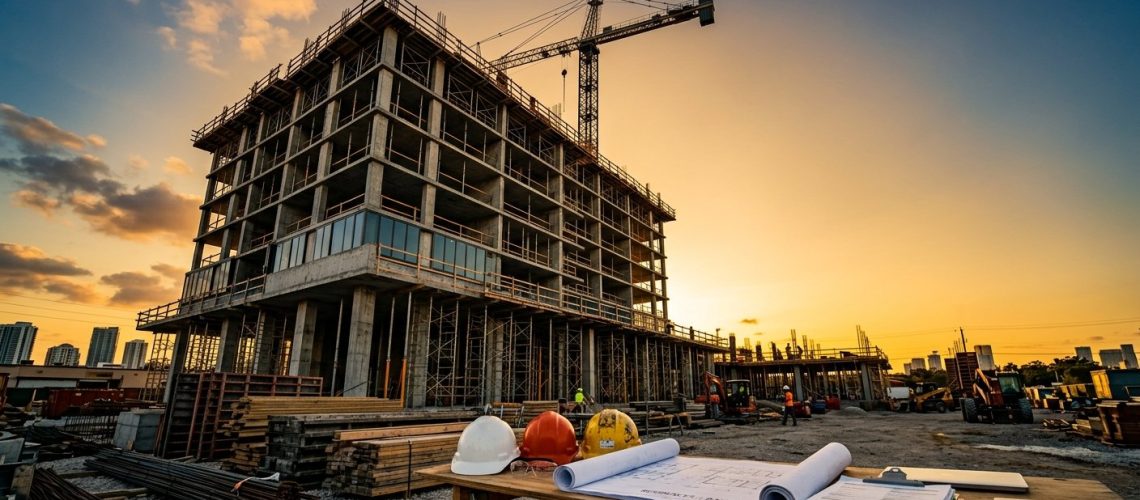
A construction project stalls mid-build. Subcontractors stop showing up. Materials orders go unfulfilled. The general contractor you trusted with millions of dollars quietly files for bankruptcy — and now your project timeline, your investment, and your relationships with future tenants or hotel guests are all on the line.
This isn’t a rare horror story. In South Florida’s active development market, financially unstable contractors have derailed multi-family, mixed-use, and hospitality projects that looked promising on paper. For real estate developers, property owners, and architects in Miami-Dade, Broward, and Palm Beach Counties, understanding how to evaluate a GC’s financial health before signing isn’t just due diligence — it’s self-protection.
Here’s how to do it thoroughly and confidently.
Why a GC’s Financial Stability Matters More Than You Think
Most developers focus on a contractor’s portfolio, references, and bid price. These matter. But they don’t tell you whether a GC can actually float the operational costs of your project between payment applications, pay their subs on time, maintain proper insurance, and absorb unexpected expenses without cutting corners.
A financially stressed contractor makes decisions driven by cash flow, not quality. They may delay purchasing materials, underpay subcontractors, defer inspections, or staff your project with less-experienced crews to reduce overhead. None of this becomes visible until you’re already mid-project and the damage is done.
The Associated General Contractors of America consistently identifies financial instability as one of the leading root causes of construction disputes, project delays, and contractor defaults. Knowing what to look for before you sign protects your investment and your timeline.
Start With Bonding Capacity and Surety Relationships
One of the most reliable indicators of a GC’s financial health is their bonding capacity — specifically, their ability to secure a performance bond and payment bond on your project.
A surety company essentially acts as a financial backstop. Before issuing a bond, they conduct a rigorous underwriting process that evaluates the contractor’s working capital, net worth, cash flow, backlog, and management team. If a GC can’t get bonded — or can only obtain a bond for a fraction of your project’s value — that’s a serious red flag.
When vetting south florida general contractors, ask directly:
- Who is your surety company, and what is your current bonding capacity?
- Can you provide a letter of bondability from your surety agent?
- Have you had any bond claims made against you in the past five years?
A healthy, established GC will answer these questions without hesitation. Evasiveness or vague answers here should prompt deeper scrutiny.
Request Financial References and Review Payment History
Speaking directly with subcontractors who have worked with a GC is one of the most revealing steps you can take. Subs know, often before anyone else, when a GC is struggling financially — because they’re the first to feel delayed or shorted payments.
Ask the GC for a list of subcontractors from their last two or three projects. Then call them. Specifically ask:
- Were you paid consistently and on schedule?
- Did you ever file or consider filing a lien?
- Would you work with this GC again?
You can also search public records in Florida for filed mechanic’s liens or notices of non-payment associated with the contractor’s name or projects. The Florida Attorney General’s office and county clerk databases in Miami-Dade, Broward, and Palm Beach counties are accessible resources for this kind of search.
A pattern of lien filings or subcontractor disputes is one of the clearest signs of financial distress — even if the contractor has an impressive project portfolio.
Evaluate Working Capital and Overhead Structure
You don’t need to be a CPA to evaluate basic financial health indicators. When working with commercial general contractors in Florida on large-scale projects, it’s entirely appropriate to request:
- A reviewed or audited financial statement from the past 12–24 months
- Evidence of a line of credit or working capital reserves
- Current backlog compared to available capacity
Working capital — the difference between current assets and current liabilities — is a foundational measure of a contractor’s ability to keep your project funded between payment draws. A GC running extremely lean on working capital relative to their project commitments may be overextended.
Backlog is equally important. A GC that has taken on more work than their team and cash flow can support is a risk, even if they’re technically profitable. Ask how many active projects they’re currently managing and whether your project would receive dedicated leadership and resources — not divided attention.
Verify Licensing, Insurance, and Standing
This step is non-negotiable. In Florida, all general contractors must hold a valid state license. You can verify this through the Florida Department of Business and Professional Regulation (DBPR). Confirm the license is current, unrestricted, and free of disciplinary actions.
Beyond licensing, confirm the following insurance coverages are in place:
- General Liability Insurance — covering property damage and bodily injury
- Workers’ Compensation Insurance — mandatory for all employees on Florida job sites
- Builder’s Risk Insurance — covering the project itself during construction
- Umbrella/Excess Liability — for large-scale commercial and multi-family projects
A financially stable GC maintains these coverages continuously and without lapses. Ask for certificates of insurance naming you as an additional insured, and verify them directly with the insurer — don’t rely solely on what’s handed to you. Licensed and insured isn’t just a checkbox; it’s a reflection of how a contractor manages their obligations.
Look for the Indicators of Long-Term Thinking
Financial health isn’t only measured in numbers. It’s also reflected in how a contractor approaches relationships, communication, and long-term reputation.
Miami general contractors and south florida construction companies that are financially strong typically share a few common traits: they’re transparent about their processes, they have consistent senior leadership, they maintain long-standing relationships with the same subcontractors and suppliers, and they’re not chasing every bid in the market. They’re selective about the projects they take on because they care about delivering quality — not just volume.
When evaluating a potential GC partner, consider:
- How long have their key project managers and field superintendents been with the company?
- Do they have preferred subcontractor relationships built over years, not just whoever bids lowest?
- Are they able to clearly explain their change order and dispute resolution process?
- Do they proactively communicate risks, or do they avoid difficult conversations?
These are the hallmarks of a contractor who will still be performing at a high level six months into your project — not just during the proposal phase.
Commercial Construction Management and Fiscal Oversight
For larger or more complex projects — mixed-use developments, multi-family residential communities, or full-service hospitality builds — working with a firm that also offers commercial construction management services adds a layer of fiscal oversight to your project. A construction manager operating in your interest monitors not just schedule and quality, but also cost tracking, payment applications, and subcontractor compliance.
If you’re developing multi-family properties or hospitality projects across South Florida, having a partner with both GC experience and a stakeholder mentality means you’re never flying blind on the financial side of your build.
Frequently Asked Questions
What documents should I request to evaluate a GC’s financial health?
At minimum, request a reviewed or audited financial statement, a letter of bondability from a surety agent, current certificates of insurance, and references from subcontractors on recent projects. For larger builds, you may also request a credit reference from their primary supplier or a bank reference letter.
Is it normal to ask a GC for financial information before signing?
Yes — and a reputable GC will expect it on commercial and multi-family projects. Any hesitation or resistance to providing standard financial documentation is itself a warning sign. Transparent contractors understand that this is part of a professional, trustworthy business relationship.
How do I check if a Florida GC has had lien claims or legal disputes?
You can search Florida county clerk records in Miami-Dade, Broward, or Palm Beach Counties for filed mechanics’ liens or court actions tied to a contractor’s name or license number. The DBPR also maintains disciplinary records tied to contractor licenses in Florida.
What does it mean if a GC can’t get a performance bond?
It typically means a surety underwriter has determined the contractor lacks the working capital, net worth, or project management capacity to back a bond on your project. This is a serious financial red flag and warrants significant caution before proceeding.
How does a GC’s backlog affect my project?
A GC carrying more work than their team and cash flow can support may spread resources too thin. This can lead to scheduling conflicts, delayed material procurement, and reduced management attention on your project. Always ask about current active projects and how your work fits into their capacity.
Build on a Solid Foundation — In Every Sense
Choosing a general contractor is one of the most consequential decisions you’ll make in any development project. The right partner doesn’t just have the portfolio or the bid number you’re hoping for — they have the financial foundation, the team depth, the relationships, and the transparency to carry your project through to completion with integrity.
At Ortega’s Building & Construction, we’ve built our reputation in South Florida over more than 10 years of hands-on South Florida construction experience. We’re a licensed, insured, and relationship-driven firm serving developers, architects, and property owners across Miami-Dade, Broward, and Palm Beach Counties — and we believe that transparency about how we operate, including our financial practices, is the foundation of every great partnership.
If you’re planning a multi-family, mixed-use, or hospitality project and want to work with a GC you can trust, we’d love to have that conversation. Contact Ortega’s Building & Construction today to learn more about how we approach your project like it’s our own.