
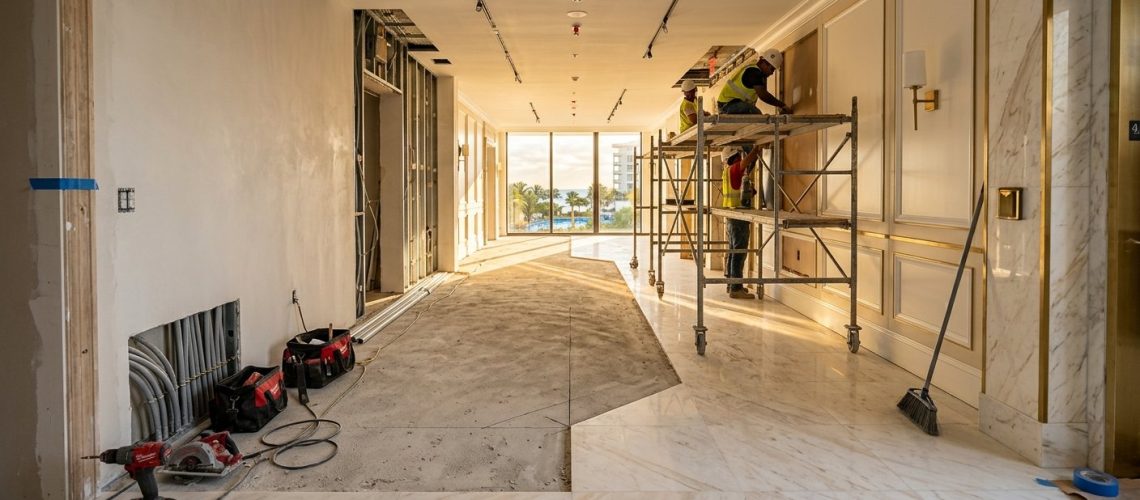
Hotel renovation projects in South Florida move fast — or they should. With occupancy rates in Miami-Dade, Broward, and Palm Beach Counties consistently outperforming national averages, a property sitting in renovation limbo isn’t just inconvenient. It’s expensive. Every day a room is out of service is revenue walking out the door.
Whether you’re refreshing a boutique property in Fort Lauderdale’s Flagler Village or completing a full gut renovation of a beachfront resort in Boca Raton, the decisions you make before the first wall comes down will shape the outcome of the entire project. This guide walks South Florida hotel owners and developers through the critical factors that determine renovation success — from planning and permitting to contractor selection and construction management.
Why South Florida Hotel Renovations Are Uniquely Complex
Hospitality construction in South Florida isn’t the same as building a standard commercial office or retail center. Hotels are living, breathing operations. Many renovations happen while guests are still on-site, which means work schedules, noise, and access must be carefully managed to protect your brand and your reviews.
On top of that, South Florida’s coastal environment introduces construction challenges that inland markets simply don’t face: salt air corrosion, hurricane-code compliance, high humidity affecting materials and timelines, and aging infrastructure in many of the region’s legacy hospitality properties. The Florida Building Code sets stringent standards that your contractor must understand thoroughly — not just generally.
Then there’s the permitting landscape. Miami-Dade, Broward, and Palm Beach Counties each have distinct municipal processes. A contractor who is only familiar with one county’s system can cost you weeks in delays simply from navigating the wrong workflow with the wrong agency.
Start With a Clear Renovation Scope
Before engaging a contractor, hotel owners need to define what kind of renovation they’re undertaking. The scope will determine your budget, your timeline, your permitting requirements, and ultimately the type of construction management team you need.
Cosmetic vs. Structural Renovation
Cosmetic renovations — new flooring, furniture, fixture upgrades, paint, and soft goods — are lower risk and more predictable. Structural renovations, on the other hand, involve MEP (mechanical, electrical, plumbing) systems, HVAC replacement, elevator modernization, or structural modifications. These require licensed professionals, detailed engineering plans, and more intensive permitting.
Most South Florida hotel owners we work with are doing some version of both: a property improvement plan (PIP) driven by a flag brand or investor requirements, layered on top of aging infrastructure that hasn’t been touched in 15 to 20 years. That combination requires experience and careful phasing.
Phased Renovations Keep Revenue Flowing
One of the most effective strategies for full-service hotels is a phased renovation approach. Rather than closing the entire property, the project is segmented by floor, wing, or amenity area. This keeps revenue-generating rooms available throughout the project. It also requires a construction management partner with strong scheduling discipline — because a poorly phased renovation can be worse than closing entirely.
At Ortega’s Building & Construction, our hospitality construction management approach is built around exactly this kind of strategic thinking. We understand that your hotel isn’t just a building — it’s a guest experience, a brand promise, and a financial asset.
Choosing the Right Hotel Renovation Contractor
This is where owners make or break a project. Selecting a hotel renovation contractor in Miami or anywhere in South Florida requires more than checking a license number and reviewing a portfolio. You need a team that understands how to operate within a live hospitality environment.
What to Look for in a Hospitality Contractor
- Proven experience in hospitality construction — Not just commercial construction broadly, but hotels specifically. Guest-facing spaces have zero tolerance for unfinished details.
- Local South Florida presence — A team embedded in Miami-Dade, Broward, and Palm Beach Counties brings relationships with local subcontractors, inspectors, and suppliers that accelerate your project.
- Licensed and insured — This is non-negotiable. Verify contractor licensing through the Florida Department of Business and Professional Regulation before signing anything.
- Construction management capabilities — The best hospitality projects are managed, not just built. You want a team that tracks schedules, coordinates subcontractors, manages inspections, and communicates proactively.
- Brand standard familiarity — If your property is flagged (Marriott, Hilton, Hyatt, IHG, etc.), your contractor needs to understand PIP compliance and brand-specific requirements.
With more than 10 years of hands-on South Florida construction experience, our team at Ortega’s has built relationships in this market that directly benefit our hospitality clients — from trusted subcontractor networks to institutional knowledge about local permitting nuances that simply can’t be replicated by out-of-market contractors.
Construction Management: The Backbone of a Successful Renovation
Large-scale hotel renovations are extraordinarily complex coordination efforts. On any given day, you might have tile setters working in guest rooms, HVAC crews in the mechanical penthouse, exterior waterproofing on the building envelope, and landscaping crews along the entry drive — all happening simultaneously without disrupting guests checking in at the front desk.
Professional construction management is what makes that possible. A skilled construction manager serves as the central hub — scheduling trades, managing submittals and RFIs, tracking budget against scope, and keeping the owner informed through transparent reporting. Without it, even well-funded renovations can spiral.
Budget Management and Contingency Planning
Hotel renovations are notorious for uncovering surprises: asbestos in older properties, outdated electrical panels that can’t support modern systems, water damage hidden behind tile, or structural concerns that weren’t visible until demolition. That’s not a flaw in planning — it’s the reality of working in existing structures.
Experienced construction managers plan for this. A realistic contingency budget (typically 10–15% for older properties) and a proactive scope management process mean that surprises don’t become crises. Owners who skip this step often find themselves making reactive decisions under financial pressure.
Navigating Permits and Inspections in South Florida
Permitting timelines are one of the biggest variables in any South Florida hotel renovation. Cities like Miami Beach, Fort Lauderdale, and West Palm Beach have their own building departments with unique submission requirements, review timelines, and inspection processes. Historic properties add another layer — any structure within a historic district may require additional review and approval before modifications are made.
Your contractor should own the permitting process on your behalf. This means preparing complete, code-compliant permit packages the first time, following up actively with building departments, and scheduling inspections at the right project milestones. Delays in permitting don’t just push your schedule — they affect your financing, your team’s momentum, and sometimes your franchise agreement deadlines.
Sustainability and Technology in Modern Hotel Renovations
Today’s hotel owners and their guests expect more from renovated properties. Sustainable building practices — LED lighting systems, low-flow water fixtures, energy-efficient HVAC, and smart building controls — are no longer luxury add-ons. They reduce long-term operating costs and increasingly influence guest satisfaction scores and brand positioning.
In 2026, South Florida hotel renovations are also incorporating EV charging infrastructure, high-bandwidth in-room technology systems, and contactless access across the property. These upgrades require careful coordination between your construction team, your technology vendors, and your brand standards — another reason why experienced construction management is worth the investment.
Frequently Asked Questions
How long does a typical hotel renovation take in South Florida?
It depends significantly on scope. A cosmetic refresh of 50 to 100 rooms can be completed in 8 to 16 weeks with phased scheduling. A full property renovation involving MEP systems, structural work, and exterior improvements on a mid-size hotel typically runs 12 to 24 months. Local permitting timelines in Miami-Dade, Broward, and Palm Beach Counties are a major variable and should be factored into planning from day one.
Do I need to close my hotel during renovation?
Not necessarily. Most South Florida hotel renovations are executed in phases specifically to keep portions of the property operational and revenue-generating. This requires careful sequencing, a disciplined construction management team, and proactive communication with guests. A full closure may be appropriate for extreme structural renovations or smaller boutique properties where phasing isn’t practical.
What permits are required for a hotel renovation in Florida?
Permitting requirements vary by county and municipality. At minimum, most renovations require a building permit. Structural modifications, MEP work, fire safety upgrades, and exterior changes trigger additional permit categories. Properties in historic districts require separate approvals. A licensed general contractor familiar with your specific municipality will manage this process and prepare compliant permit packages on your behalf.
How do I choose between a general contractor and a construction manager for my hotel renovation?
For complex hotel renovations, the distinction matters less than the firm’s experience in hospitality. Many owners benefit from a firm that offers both general contracting and construction management capabilities — meaning they can self-perform or manage subcontractors, handle permitting, and provide transparent owner-side reporting. Look for a team with specific hospitality project history in South Florida.
What should my renovation budget include beyond hard construction costs?
Your renovation budget should include soft costs such as architectural and engineering fees, permitting fees, owner-supplied furniture and fixtures (FF&E), technology systems, a contingency reserve (10–15% for older properties), and any brand compliance or PIP-related requirements from your franchise. Missing these line items is a common cause of budget overruns on hotel renovation projects.
Building Something That Lasts
A hotel renovation is more than a construction project. It’s a reinvestment in your property’s future, your guests’ experience, and the community your hotel serves. South Florida’s hospitality market rewards properties that are well-maintained, thoughtfully designed, and built to handle the demands of our coastal environment.
At Ortega’s Building & Construction, we bring a stakeholder mentality to every hospitality project we take on. We’re not just your contractor — we’re your partner in protecting and growing one of your most significant assets. Our team serves hotel owners and developers across Boca Raton, Miami, Fort Lauderdale, and West Palm Beach with the same family-driven commitment to quality that has defined our legacy for generations.
Ready to discuss your South Florida hotel renovation? Contact Ortega’s Building & Construction today and let’s build something that stands the test of time — together.