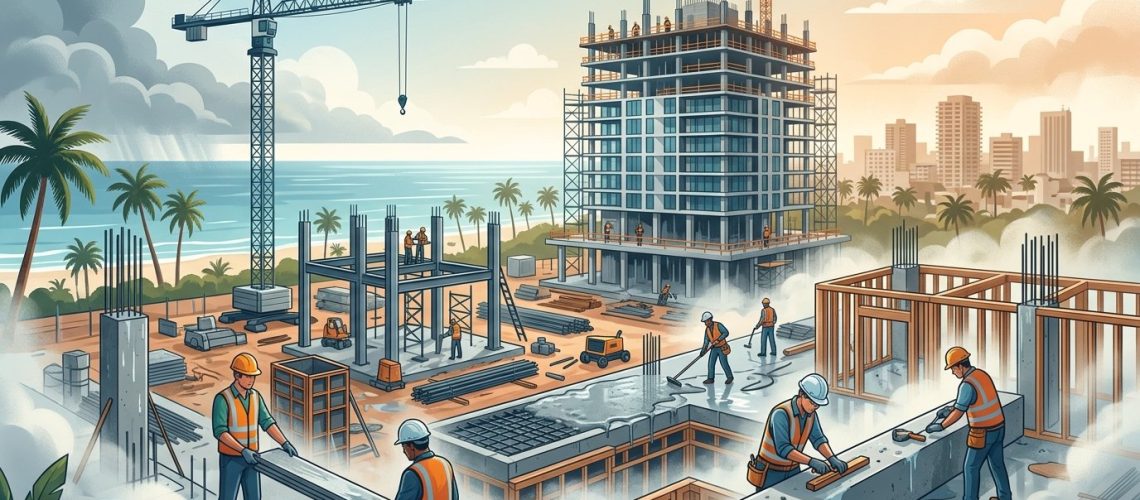
South Florida averages over 75% relative humidity for much of the year. For developers and property owners planning multi-family, mixed-use, or hospitality projects in Miami-Dade, Broward, or Palm Beach Counties, that number isn’t just a weather statistic — it’s a project management reality that touches everything from concrete curing schedules to interior finish timelines.
Understanding how humidity affects construction timelines isn’t about making excuses for delays. It’s about planning smarter, partnering with the right team, and building something that lasts for generations. At Ortega’s Building & Construction, we’ve built our entire approach around this reality — because South Florida is what we know, and what we know, we do well.
Why Humidity Is a Construction Variable, Not Just a Weather Condition
Most people think of humidity as a comfort issue. On a job site, it’s a performance issue. When ambient moisture is high, it directly interferes with how construction materials behave — sometimes slowing the work, sometimes creating long-term quality risks if not managed properly.
According to the National Oceanic and Atmospheric Administration (NOAA), South Florida’s wet season runs from June through September, with average humidity levels regularly exceeding 80% during peak afternoon hours. This is not a temporary inconvenience — it’s a seasonal pattern that every project schedule in our region must account for.
Concrete Curing and High Moisture Environments
Concrete is one of the most humidity-sensitive materials in construction. While concrete requires some moisture to cure properly, excessive ambient humidity slows the evaporation process, which can extend curing times and affect surface finishing windows. In practical terms, this means form stripping schedules may shift, subsequent structural work can be delayed, and finish trades may need to hold off longer than originally planned.
For multi-family developments and mixed-use structures where multiple floors are being poured in sequence, even modest delays per floor can compound into meaningful schedule adjustments.
Wood Framing, Drywall, and Moisture Absorption
Wood framing absorbs atmospheric moisture during high-humidity periods. This can cause dimensional changes — swelling, warping, or slight movement — that affect how drywall is installed, how doors and windows fit, and how trim work aligns. When moisture is present in framing before drywall is hung, there’s also a risk of mold developing behind walls if the project isn’t properly monitored and ventilated.
The U.S. Environmental Protection Agency’s guidance on mold prevention makes clear that controlling moisture during construction is one of the most important steps in protecting long-term indoor air quality — particularly relevant in South Florida’s climate.
Exterior Coatings, Sealants, and Adhesives
Paint, sealants, and adhesives all have application windows defined by temperature and humidity thresholds. In South Florida summers, the combination of heat and humidity can push conditions outside manufacturer specifications, especially during afternoon hours. Applying coatings in non-compliant conditions doesn’t just delay drying — it can result in poor adhesion, blistering, or premature failure that drives costly rework down the line.
Experienced South Florida construction management teams build these windows into daily scheduling — prioritizing exterior coating work in early morning hours before humidity peaks, or sequencing interior work during afternoon sessions.
How Humidity Affects Specific Project Types
Multi-Family Residential Construction
In multi-family projects — garden apartments, mid-rise condos, mixed-use residential — humidity management affects nearly every phase. From the foundation through framing, rough-in trades, and finishes, each stage has moisture sensitivities that must be managed sequentially. Rushing any one phase in high humidity conditions risks compromising the next. That’s why our multi-family construction approach integrates climate-aware scheduling from the preconstruction phase forward.
Hospitality and Hotel Construction
Hospitality projects carry an additional layer of sensitivity: the finishes and materials used in hotels and resorts are often high-specification. Luxury flooring, millwork, decorative tile, and custom wall coverings are all more susceptible to moisture damage than standard commercial finishes. For a hospitality project opening on a defined date tied to marketing campaigns and booking launches, humidity-related delays during finish-out can create real commercial consequences. Our hospitality construction team plans extensively for these vulnerabilities well in advance.
Commercial Mixed-Use Developments
Mixed-use projects — with retail, commercial, and residential components — often have tenant commitments tied to construction milestones. Humidity-driven delays on one component can ripple into tenant delivery deadlines. Proactive commercial construction management in South Florida means building buffer time, sequencing work intelligently, and maintaining transparent communication with all stakeholders when conditions require adjustment.
How Experienced General Contractors Plan Around Humidity
The difference between a project team that understands South Florida humidity and one that doesn’t shows up not in conversations — it shows up in schedules, budgets, and finished buildings.
Here’s how seasoned Miami general contractors and South Florida construction management teams address humidity proactively:
- Climate-informed scheduling: Sequencing trades around humidity patterns — scheduling moisture-sensitive work in morning hours or dry-season windows whenever possible.
- Temporary climate control: Deploying temporary dehumidification and HVAC systems during interior finish phases to create controlled environments, particularly in hospitality and high-end residential projects.
- Material staging protocols: Storing humidity-sensitive materials — drywall, flooring, millwork — in climate-controlled conditions on-site until installation, rather than leaving them exposed.
- Moisture testing before covering: Testing concrete slabs for moisture vapor emission before flooring installation to prevent adhesion failures and floor covering failures after occupancy.
- Contractor coordination: Ensuring subcontractors understand humidity-related application windows and are held accountable to manufacturer specifications — not just general practice.
- Honest schedule communication: Keeping owners, architects, and development partners informed when humidity conditions require schedule adjustments, rather than pushing work that will fail later.
These aren’t extraordinary measures for our team — they’re standard operating procedure for any contractor that genuinely knows South Florida construction.
The Long-Term Cost of Getting It Wrong
Some projects push through humidity challenges without the right precautions — and the consequences often don’t appear until after occupancy. Mold behind walls, flooring failures, paint delamination, and window seal failures are all common outcomes when moisture isn’t properly managed during construction.
For a property owner or developer, post-occupancy defects are far more expensive than the schedule adjustments required to do the work right. They affect tenant relationships, property reputation, and long-term asset value. With more than 10 years of hands-on South Florida construction experience, we’ve seen what cutting humidity-related corners looks like years down the road — and we build accordingly.
Generational thinking means building something that performs not just at ribbon-cutting, but five, ten, and twenty years from now. That’s not a marketing phrase for us — it’s the lens through which we make every decision on every project.
Frequently Asked Questions
Does South Florida humidity always delay construction projects?
Not necessarily. When humidity is factored into the project schedule from the beginning, many delays can be avoided or minimized. Experienced South Florida general contractors build climate-aware schedules that account for seasonal humidity patterns, allowing projects to move forward efficiently without compromising quality.
What time of year is best to start a construction project in South Florida?
Many developers prefer to begin projects in the fall or early winter (October through February) to maximize the dry-season window for early structural and exterior work. However, multi-year projects will always span wet seasons, so proper planning and climate management practices matter more than start date alone.
How do contractors prevent mold during construction in humid climates?
Key strategies include controlling material storage, using temporary dehumidification systems during interior phases, scheduling moisture-sensitive work during lower-humidity windows, and testing for moisture before enclosing assemblies. Proper site drainage and rapid installation of building envelope elements also reduce exposure risk significantly.
Does humidity affect the cost of a construction project?
Humidity-related precautions — temporary climate control, extended curing periods, careful material handling — do add costs to projects in South Florida. However, these costs are significantly lower than post-construction remediation for mold, flooring failures, or coating failures caused by cutting corners during construction.
How does a construction management firm help manage humidity-related risks?
A skilled construction management team builds humidity considerations into the preconstruction schedule, coordinates subcontractors around optimal working conditions, monitors moisture levels throughout the project, and maintains transparent communication with owners and architects. This proactive approach reduces both schedule risk and long-term quality risk.
Build with a Team That Knows South Florida
South Florida’s humidity is not a problem to be solved — it’s a reality to be respected and planned for. The developers, architects, and property owners who build the most successful projects here do so with partners who understand that truth from day one.
At Ortega’s Building & Construction, our licensed and insured team serves Miami-Dade, Broward, and Palm Beach Counties — Boca Raton, Miami, Fort Lauderdale, and West Palm Beach — with the kind of hands-on, relationship-driven approach that South Florida projects demand. We don’t just manage construction. We invest in your project’s success as if it were our own.
If you’re planning a multi-family, mixed-use, or hospitality project in South Florida and want a construction partner who plans ahead, communicates openly, and builds to last — we’d love to start that conversation. Contact Ortega’s Building & Construction today to discuss your project and learn how we can put decades of South Florida experience to work for you.