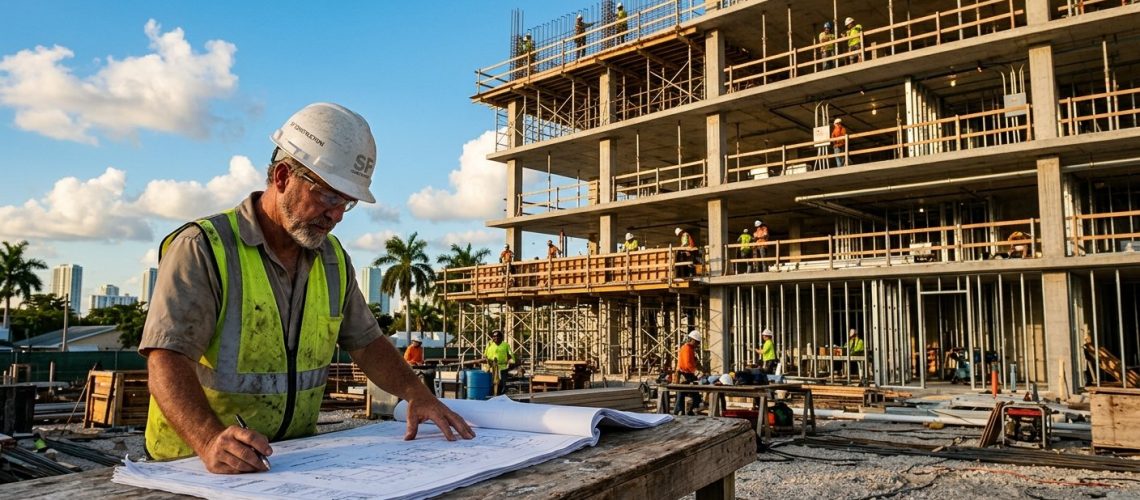
Ask any experienced developer in Miami-Dade, Broward, or Palm Beach County what keeps them up at night, and subcontractor coordination will land near the top of the list. On a complex multi-family or hospitality project, you might have 20 or more specialty trades working across the same building at the same time — electrical, plumbing, HVAC, concrete, framing, drywall, tile, roofing, and more. When those relationships are managed well, projects move like a well-rehearsed team. When they’re not, the ripple effects can delay timelines, spike costs, and damage the trust you’ve worked hard to build with lenders, tenants, and partners.
At Ortega’s Building & Construction, subcontractor management isn’t just a scheduling exercise — it’s a relationship-driven discipline rooted in our more than 10 years of hands-on South Florida construction experience. Here’s what that actually looks like on the ground, and why it matters for your next project.
Why Subcontractor Management Is Different in South Florida
South Florida has a construction market unlike almost anywhere else in the United States. The permitting environments across Miami-Dade, Broward, and Palm Beach Counties each have their own rhythms, code requirements, and inspection standards. Labor demand is fierce, particularly for licensed trades, and material supply chains — while more stable than they were a few years ago — still require smart forward planning. On top of that, building in a coastal environment means certain systems (waterproofing, impact-resistant glazing, HVAC specifications) carry higher stakes than they would in other regions.
This means the general contractor’s role as the orchestrator of subcontractors carries enormous weight. Poor coordination doesn’t just cause inconvenience — it can result in costly rework, code violations, or inspection failures that push project timelines by weeks or months. For developers building multi-family residential or mixed-use properties, that delay translates directly to lost revenue. According to the Associated General Contractors of America, schedule overruns are among the most cited risk factors in commercial construction, and a large percentage trace back to subcontractor mismanagement.
Building the Right Subcontractor Network
Successful subcontractor management starts long before the first shovel breaks ground. It starts with who you bring to the table.
Vetting for Quality, Not Just Price
One of the most common mistakes in construction procurement is selecting subcontractors based primarily on bid price. A low number on paper can quickly become a very expensive decision once work begins. At Ortega’s, we evaluate subcontractors on a combination of factors:
- Licensure and insurance: Every subcontractor on our projects must be fully licensed and insured in accordance with Florida state requirements — no exceptions.
- Track record in South Florida: Local experience matters. A subcontractor who understands South Florida’s building codes, inspection culture, and weather-related scheduling considerations is a different asset than one who doesn’t.
- Financial stability: A sub that runs into cash flow problems mid-project creates problems for everyone. We look at business health, not just bid sheets.
- Cultural fit: This one gets overlooked, but it’s real. A subcontractor who communicates proactively, shows up prepared, and treats the jobsite with respect makes every other aspect of the project easier.
Long-Term Relationships Over One-Off Transactions
The best subcontractor relationships are partnerships that grow over time. When we bring the same trusted trades onto multiple projects, they understand our processes, our quality expectations, and our communication style. That familiarity reduces friction, shortens the learning curve on each new job, and builds the kind of mutual accountability that keeps quality high. It’s the same principle that guides how we work with developers and architects — relationships built on trust consistently outperform one-time transactions.
Communication and Coordination on the Jobsite
Even with great subcontractors, the real work of management happens in real time on the jobsite. Effective communication systems are non-negotiable.
Structured Scheduling and Sequencing
Multi-family and hospitality projects — the types we specialize in across our multi-family construction and hospitality construction services — involve layered trade sequences that must be carefully planned. Rough-in mechanical, electrical, and plumbing work has to be completed and inspected before framing can close in. Elevator shafts, stairwells, and common areas have coordination requirements that affect multiple trades simultaneously.
We use detailed three-week lookahead schedules combined with master project schedules to keep everyone aligned. These aren’t passive documents — they’re active tools reviewed in weekly subcontractor coordination meetings where conflicts are identified and resolved before they become problems.
Documentation and Accountability
Every instruction, change, and decision gets documented. Change orders are written and signed before work proceeds. RFIs (Requests for Information) are tracked with response timelines. Daily reports capture what work was completed, what materials were delivered, how many workers were on site, and any issues that arose. This documentation culture protects all parties — subs, owners, and the general contractor — and it creates a clear project record that’s invaluable if questions arise later.
The Occupational Safety and Health Administration (OSHA) also requires specific documentation standards on commercial construction sites. Maintaining thorough records supports compliance, protects workers, and reflects a professional operation that serious developers and lenders expect to see.
Quality Control as a Shared Responsibility
Quality control in subcontractor management isn’t about policing tradespeople — it’s about building shared ownership of the finished product. When subcontractors understand that their reputation is tied to the outcome, and when the general contractor’s team conducts consistent inspections as a collaborative check rather than a punitive one, the quality culture of the whole project rises.
Our commercial construction management approach includes structured quality checkpoints at each critical phase of work. We don’t wait for the final inspection to discover issues — problems caught early cost a fraction of what they cost when discovered at closeout. This proactive approach to quality is one of the things we hear most often from clients who have worked with general contractors that operated differently.
Inspections and Punch Lists
Phase inspections, pre-drywall inspections, and pre-close-out walkthroughs with each trade keep accountability tight throughout the project. Punch lists are issued promptly and tracked to completion. Subcontractors who consistently perform well earn more work. Those who don’t meet standards are addressed directly, professionally, and early — not at the end of the job when everyone’s frustrated and the schedule is already compromised.
Managing Risk Across Trade Packages
Subcontractor risk is real and manageable when it’s planned for. A few areas worth highlighting for South Florida builds specifically:
- Insurance verification: Certificates of insurance should be verified at the start of a project and monitored for renewals throughout. Expired coverage is a liability exposure that falls back on the general contractor and ultimately the owner.
- Lien waivers: Florida’s lien laws are strict, and proper lien waiver collection from subcontractors and suppliers protects property owners from double-payment exposure. This is a non-negotiable part of proper subcontractor administration.
- Material procurement coordination: For trades that supply and install — mechanical, electrical, plumbing, and specialty finishes — procurement timelines need to be tied to the project schedule from day one. A custom elevator cab with a 16-week lead time can’t be ordered in week eight.
The Human Side of Managing a Trade Team
Construction is still fundamentally a people business. The skilled tradespeople who build South Florida’s apartment communities, hotels, and mixed-use developments are professionals who take pride in their craft. Treating them with respect, paying them on time, communicating clearly, and creating a safe, organized jobsite goes a long way toward getting their best work.
When Ortega’s takes on a project, we see every member of the extended project team — subs, vendors, inspectors, architects, and owners — as stakeholders in the outcome. That perspective shapes how we manage every relationship on the job. It’s a family value as much as it’s a business strategy, and it’s one that has served us well across generations of South Florida construction.
Frequently Asked Questions
What is the general contractor’s responsibility in managing subcontractors?
A general contractor is responsible for selecting, coordinating, scheduling, and overseeing all subcontractors on a project. This includes verifying licensure and insurance, managing schedules and sequencing, conducting quality inspections, handling documentation, and ensuring that all trades meet project specifications and code requirements.
How do South Florida general contractors select subcontractors?
Experienced South Florida general contractors evaluate subcontractors based on licensure, local experience with Florida building codes, insurance coverage, financial stability, past performance, and communication reliability — not bid price alone. Long-term trade relationships built on mutual trust and consistent performance are often more valuable than finding the lowest bidder.
Why is subcontractor coordination especially important for multi-family projects?
Multi-family construction involves many trade packages working simultaneously across multiple units and floors. Sequencing errors — such as closing in walls before rough-in inspections are complete — can trigger costly rework and inspection failures. Tight coordination between trades keeps quality high, timelines on track, and inspection processes running smoothly.
How does a general contractor protect owners from subcontractor lien issues in Florida?
Florida has strong construction lien laws that can expose property owners to payment claims from subcontractors and suppliers. A qualified general contractor manages this risk by collecting lien waivers at each payment milestone, maintaining proper Notice to Owner compliance, and ensuring all payment flows through documented channels.
What should developers look for in a construction management partner in South Florida?
Developers should look for a licensed and insured general contractor with local South Florida experience, a proven subcontractor network, transparent communication practices, and a track record on similar project types — whether multi-family residential, mixed-use, or hospitality. A contractor who treats the project as a long-term partnership rather than a transaction is often the strongest indicator of a successful outcome.
Build With a Team That Manages Every Relationship Like It Matters
The quality of your finished project reflects the quality of every relationship on that jobsite — and subcontractor management is at the center of it all. At Ortega’s Building & Construction, we bring more than 10 years of hands-on South Florida construction experience to every project we take on in Miami-Dade, Broward, and Palm Beach Counties. We don’t just coordinate trades — we build a team culture around your project that keeps quality, safety, and communication front and center from groundbreaking to final inspection.
If you’re planning a multi-family, mixed-use, or hospitality project in Boca Raton, Miami, Fort Lauderdale, or West Palm Beach, we’d welcome the conversation. Contact Ortega’s Building & Construction today to talk about how we manage the details that make the difference between a project that meets expectations and one that exceeds them.