Most multi-family projects don’t fail during construction — they fail before a single shovel hits the ground. Missed planning steps, misaligned teams, and unclear expectations during pre-development are responsible for a disproportionate share of cost overruns and schedule delays across South Florida’s booming residential market. Understanding the full arc of a multi-family construction project — from site acquisition through final delivery — isn’t just helpful for developers. It’s essential.
Whether you’re planning a mid-rise rental community in Boca Raton, a mixed-use development in Miami’s urban core, or a workforce housing project in Broward County, the phases of construction follow a consistent framework. What changes is how well each phase is executed — and who’s guiding it alongside you.
At Ortega’s Building & Construction, our more than 10 years of hands-on South Florida construction experience has been built on one principle: being a true partner to developers and property owners at every stage, not just the ones with the visible progress. Here’s what that looks like in practice.
Phase 1: Pre-Development and Feasibility
Before anything gets designed or permitted, a developer needs clarity on whether the project is viable — financially, physically, and legally. Pre-development is where that clarity is built.
Site Evaluation
A thorough site evaluation examines soil conditions, environmental constraints, utility access, and zoning compliance. In Miami-Dade, Broward, and Palm Beach Counties, zoning regulations and local ordinances can significantly influence density, height limits, setbacks, and permitted uses. Engaging a knowledgeable local team early prevents costly surprises downstream.
Budget and Pro Forma Development
This is where developers align construction cost projections with their financial model. A realistic budget — built with input from your general contractor, not just your spreadsheet — sets the foundation for every decision that follows. Hard costs, soft costs, contingency planning, and phased funding structures all come into play here.
Contractor Engagement
Many developers wait too long to involve their construction partner. Bringing in a commercial construction management team during pre-development enables value engineering — the process of identifying design alternatives that maintain quality while reducing cost — before the design is locked in.
Phase 2: Design and Architecture
Once feasibility is confirmed, the project moves into design development. This phase typically unfolds in three stages: schematic design (concept and massing), design development (detailed layouts and systems), and construction documents (permit-ready drawings).
Collaboration between the architect, engineers, and general contractor during design development is critical for multi-family construction projects. Unit mix optimization, structural efficiency, MEP (mechanical, electrical, plumbing) coordination, and building envelope performance all have downstream cost and schedule implications.
In South Florida, design must also account for Florida Building Code requirements, wind load standards, and flood zone considerations. According to the Florida Building Commission, the state maintains one of the most comprehensive building codes in the nation — and for good reason. Compliance isn’t optional; it’s the baseline.
Phase 3: Permitting and Entitlements
Permitting is often where well-planned projects get stuck. Municipal review timelines across South Florida vary considerably — some jurisdictions have streamlined digital permitting, others remain paper-intensive. Understanding the local process is as important as having compliant drawings.
This phase includes:
- Submission of construction documents to local building departments
- Zoning and land use approvals (if not addressed in pre-development)
- Environmental and water management permittals
- Utility coordination and impact fee resolution
- Fire, health, and accessibility reviews for applicable project types
An experienced South Florida general contractor helps navigate permit comments, respond to review cycles efficiently, and maintain momentum while approvals are pending. This is not the time for your team to be learning the process on the fly.
Phase 4: Procurement and Pre-Construction
Once permits are in hand (or in some cases, in parallel for long-lead items), procurement begins. This phase is about assembling the team and resources needed to build — and it has a major impact on both schedule and budget.
Subcontractor Bidding and Selection
A responsible general contractor doesn’t just chase the lowest bid. Subcontractor qualification — reviewing bonding capacity, past performance, safety records, and workforce availability — protects the project long-term. In today’s South Florida market, labor is a competitive resource. Relationships matter.
Material Procurement
Supply chain dynamics have stabilized compared to 2021–2023, but lead times on electrical gear, elevators, and certain structural components remain extended. Locking in material orders early — especially for large multi-family projects — prevents schedule gaps in the field. The Associated General Contractors of America tracks material cost trends and supply chain conditions that inform smart procurement timing.
Pre-Construction Planning
Site logistics, construction phasing, safety planning, and schedule development all happen in pre-construction. A detailed baseline schedule — one that accounts for weather windows, inspection hold points, and subcontractor sequencing — is developed and communicated to the entire project team.
Phase 5: Construction
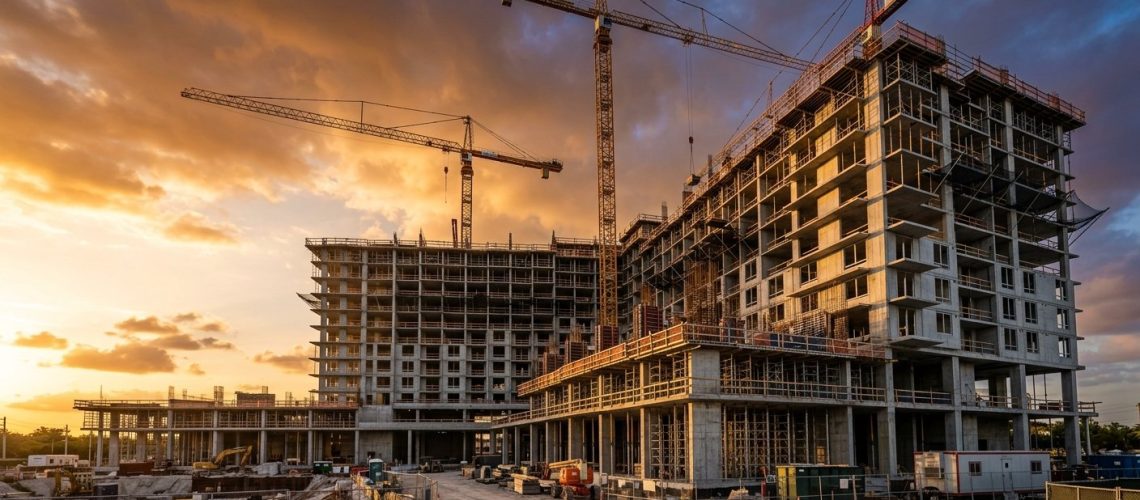
This is the visible phase — the one clients photograph and post on LinkedIn. But the quality of what happens here is almost entirely determined by how well the previous phases were managed.
Multi-family construction typically follows a vertical sequence: site work and foundations, structural framing, exterior envelope (roof and skin), rough-in MEP, insulation and drywall, finish work, and final systems commissioning. For larger communities, buildings are often phased so that early units can begin lease-up while later buildings are still under construction.
Quality Control
Quality isn’t inspected in at the end — it’s built in throughout. Established inspection protocols at each phase transition, third-party testing where required, and regular owner/architect walkthroughs keep quality visible and accountable.
Schedule and Cost Management
Weekly owner reporting, real-time cost tracking, and proactive communication around potential delays are hallmarks of professional construction management in Florida. Problems don’t get hidden; they get surfaced and solved.
Safety
Occupational safety is non-negotiable on every Ortega’s project. We’re a licensed and insured contractor, and our safety culture extends to every subcontractor and tradesperson on site. OSHA standards are the floor, not the ceiling.
Phase 6: Closeout and Turnover
Project closeout is often underestimated. This phase includes final inspections, Certificate of Occupancy (CO) procurement, punch list completion, systems commissioning and training, warranty documentation, and as-built drawing delivery.
For multi-family residential projects specifically, CO timing is directly tied to lease-up and revenue generation. A smooth closeout process — one that’s planned from the beginning, not improvised at the end — protects the developer’s financial position. Your construction partner should be as invested in that outcome as you are.
At Ortega’s, we think of closeout as the beginning of a relationship, not the end of a transaction. The projects we’re most proud of are the ones where developers call us for the next phase of development because the first one went the way it was supposed to.
Why Phase Management Matters More Than Ever in South Florida
South Florida’s multi-family market remains one of the most active in the country. Population growth, migration from other states, and constrained housing supply across Miami-Dade, Broward, and Palm Beach Counties continue to fuel demand. But market opportunity and project success aren’t the same thing. Developers who thrive here are the ones with disciplined phase management, trusted contractor relationships, and local expertise on their side.
Construction management isn’t about supervising workers. It’s about protecting your investment, your timeline, and your vision — from the first planning conversation to the last set of keys handed over.
Frequently Asked Questions
How long does a typical multi-family construction project take in South Florida?
Timelines vary based on project size and complexity, but a mid-size multi-family development in South Florida typically takes 18 to 36 months from groundbreaking to Certificate of Occupancy. Pre-development and permitting can add 6 to 18 additional months depending on the municipality and project scope. Early contractor involvement helps compress overall timelines.
When should I involve a general contractor in my multi-family project?
Ideally, during pre-development — well before construction documents are complete. Involving a Florida multi-family general contractor early enables value engineering, accurate budget development, and smoother permitting. Waiting until drawings are finalized leaves cost-saving opportunities on the table.
What’s the difference between a general contractor and a construction manager?
A general contractor typically holds the construction contract and self-performs or subcontracts the work. A construction manager provides advisory services — budget oversight, schedule management, team coordination — often during design and pre-construction as well as construction. Many South Florida developers benefit from a firm that can serve in both capacities, as Ortega’s does.
What are the most common causes of multi-family project delays in Florida?
The most frequent delay drivers include permitting holdups, design coordination gaps between the architect and engineers, late material procurement decisions, and subcontractor availability issues. Strong pre-construction planning and proactive communication throughout each phase significantly reduce these risks.
How do I evaluate a general contractor for a multi-family project?
Look for demonstrated experience in multi-family residential construction, verifiable local references, a clear project management process, safety record transparency, and genuine communication responsiveness. In South Florida specifically, familiarity with local municipalities, subcontractor networks, and Florida Building Code requirements is essential.
Build With a Team That Thinks Like an Owner
Every phase of a multi-family project is an opportunity to make smart decisions — or to defer them until they cost you more. At Ortega’s Building & Construction, we’ve spent generations building in South Florida because we care about what gets built, not just that it gets built. Our local team serves developers, property owners, and architects across Miami-Dade, Broward, and Palm Beach Counties with the attention, integrity, and experience your project deserves.
If you’re planning a multi-family development in Boca Raton, Miami, Fort Lauderdale, or West Palm Beach, we’d like to be part of the conversation from the beginning. Contact Ortega’s Building & Construction today to discuss your project and learn how our construction management approach can protect your investment at every phase.