
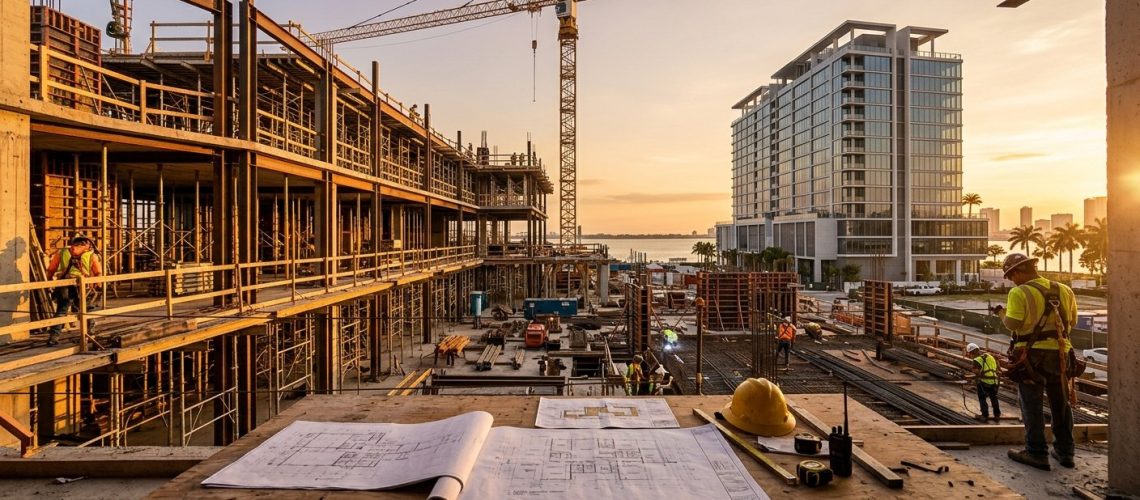
Choosing the right construction delivery method shapes every phase of your project — from budget and schedule to team dynamics and risk. For South Florida developers and property owners, the three most common approaches are Design-Bid-Build, Design-Build, and Construction Management at Risk (CMAR). Each has genuine advantages depending on your project’s complexity, timeline, and how much control you want to retain.
- Design-Bid-Build offers the most owner control but typically results in longer pre-construction timelines.
- Design-Build compresses the schedule by overlapping design and construction phases, making it ideal for hospitality and mixed-use projects.
- Construction Management at Risk gives owners a dedicated advocate while providing a guaranteed maximum price (GMP) framework.
- The South Florida market — especially multi-family and mixed-use development — increasingly favors collaborative delivery models that reduce costly change orders.
- Choosing the right method early is one of the most impactful decisions you’ll make for a project’s long-term success.
Why Delivery Method Matters in South Florida
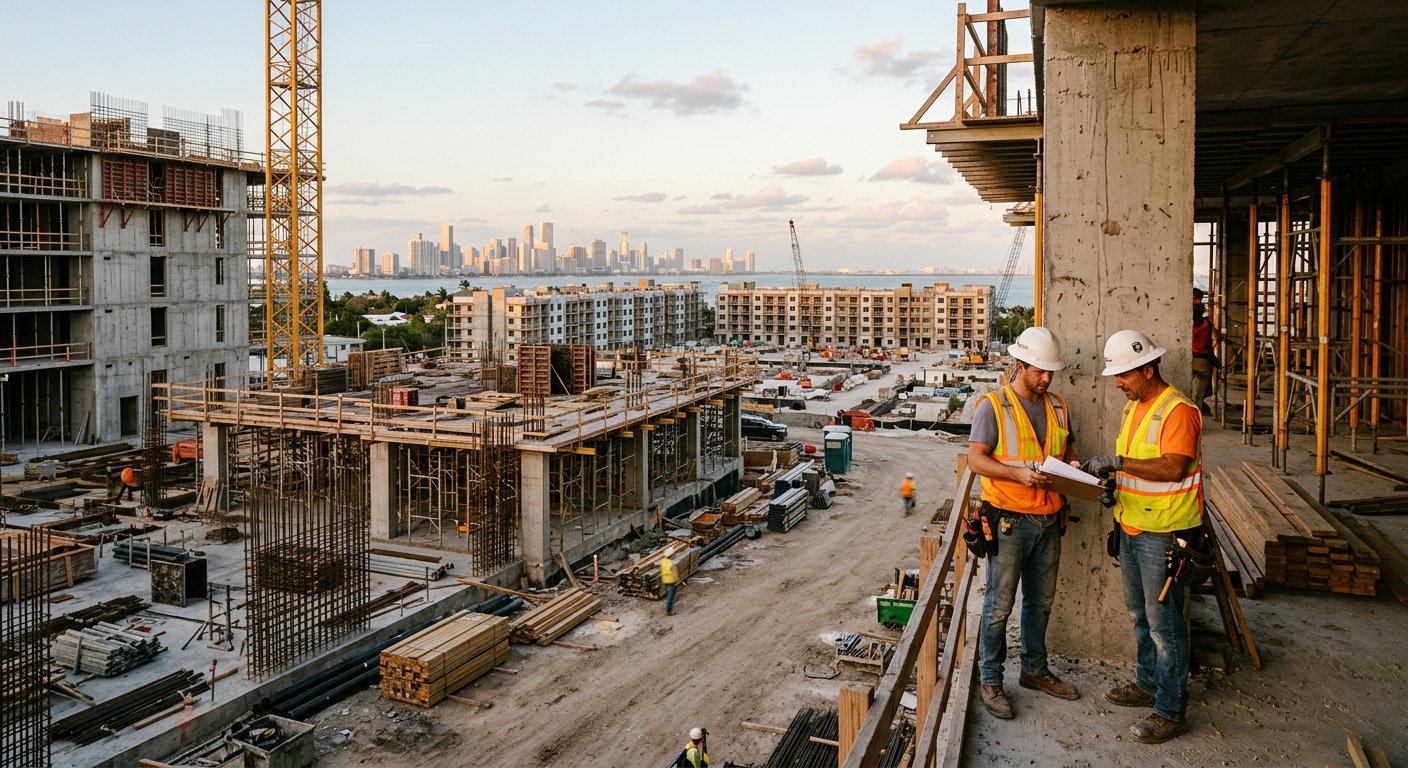
South Florida’s development pipeline remains one of the most active in the country. Miami-Dade, Broward, and Palm Beach Counties are seeing sustained demand in multi-family residential, mixed-use, and hospitality construction — and with that demand comes complexity. Labor markets are competitive. Permitting timelines through local municipalities require careful planning. Material costs fluctuate. In this environment, how a project team is assembled and who carries the risk isn’t a bureaucratic detail — it’s a strategy.
The wrong delivery method can create friction between your architect and your builder, expose you to unexpected cost overruns, or push your grand opening into a season that works against you. The right one aligns incentives, fosters communication, and gives your project the best chance of being delivered with the quality and integrity your investment deserves.
The Associated General Contractors of America reports that construction delivery method selection is among the top variables influencing project outcomes — ahead of even budget size in many categories. Making this decision early, before design development begins, is critical.
Design-Bid-Build: The Traditional Approach
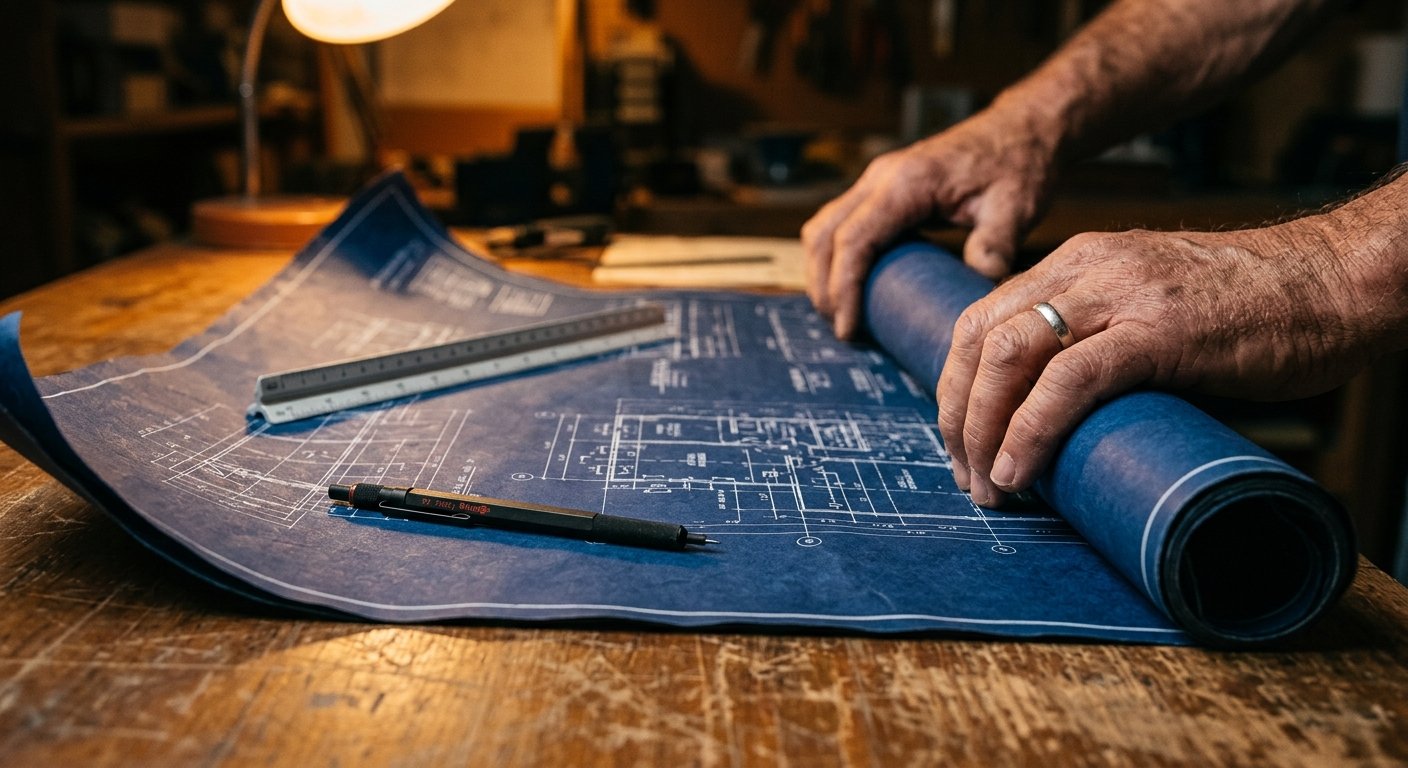
Design-Bid-Build (DBB) is the oldest and most widely understood delivery model. Here’s how it works: the owner hires an architect to complete full construction documents, then issues those documents to contractors for competitive bidding, selects the lowest qualified bid, and construction begins. Simple in concept, but the linear nature of the process has real implications.
Where It Works Well
For public projects or owners with highly specific scope requirements who want maximum pricing transparency, DBB still has a place. The competitive bidding process can be effective when design is fully complete and scope is tightly defined before breaking ground.
Where It Falls Short
In South Florida’s fast-moving development market, waiting for full design completion before engaging a contractor means you’re also waiting before anyone starts identifying constructability issues, pricing materials, or locking in subcontractor relationships. That delay can cost months. And because the contractor wasn’t involved during design, expensive surprises during construction aren’t uncommon — particularly in complex multi-family or mixed-use builds where mechanical, plumbing, and structural systems interact in nuanced ways.
Design-Build: Speed and Unified Accountability
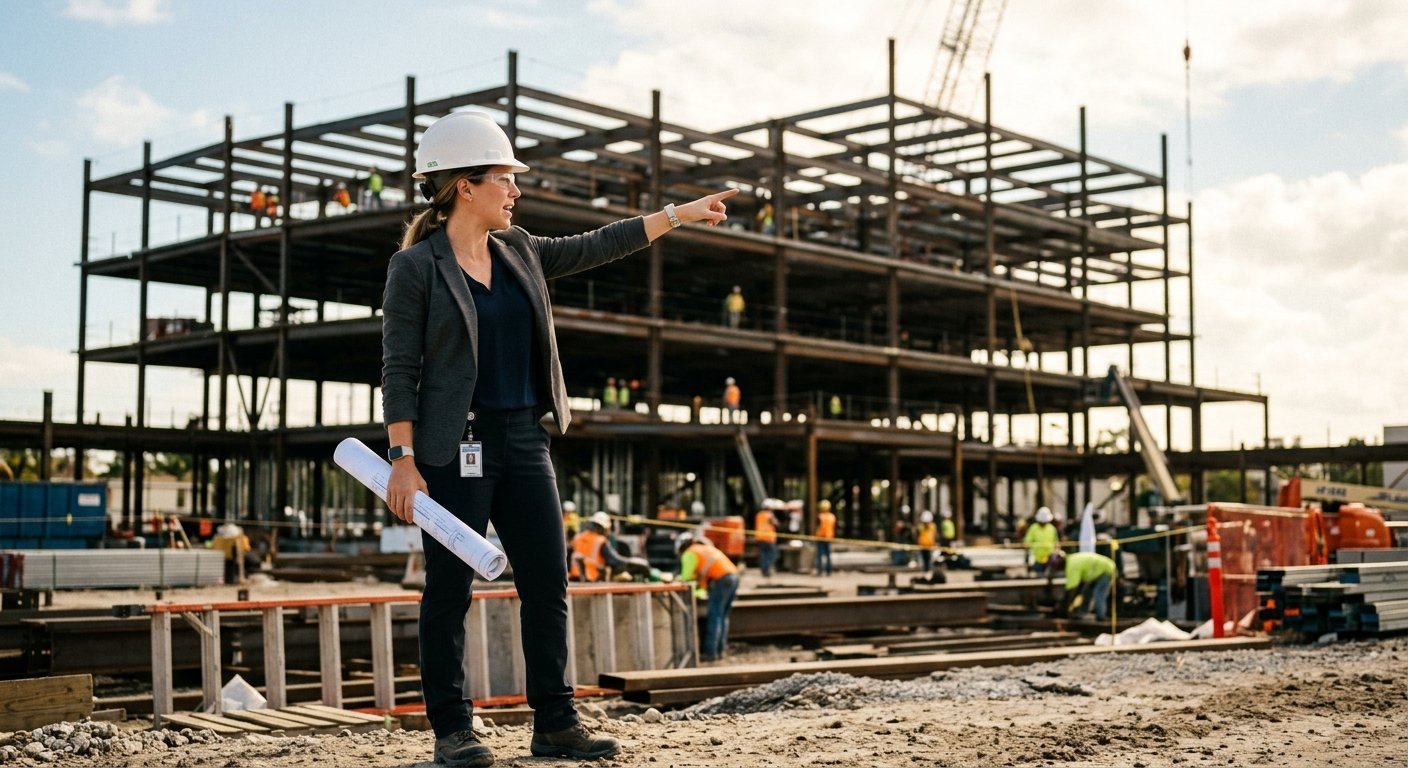
Design-Build (DB) contracts both the designer and builder under a single entity, creating one point of responsibility for the owner. Rather than a sequential process, design and construction overlap — often called “fast-tracking” — which can meaningfully compress the overall project schedule.
Benefits for Hospitality and Mixed-Use Projects
For hotel and hospitality construction in South Florida, where opening dates can be tied to peak tourism seasons, the schedule advantages of Design-Build are significant. A developer opening a boutique hotel in Miami Beach who can start foundation work while the upper-floor interiors are still being designed is operating with a real competitive advantage. Accountability is also cleaner: when an issue arises, there’s no finger-pointing between the architect and the contractor because they’re working as one coordinated unit.
Explore how Ortega’s Building & Construction approaches hospitality and hotel construction in South Florida to understand how this delivery method applies in practice.
If your project has a hard deadline — a hotel opening, a lease-up schedule, or a market window — Design-Build should be among the first options your team evaluates. The schedule compression alone often justifies the model.
Construction Management at Risk: The Collaborative Model
Construction Management at Risk (CMAR) is increasingly the delivery model of choice for sophisticated South Florida developers working on large-scale multi-family and mixed-use projects. In this model, the owner retains a separate architect but brings on a Construction Manager (CM) early — often during schematic design — who then takes on financial risk by committing to a Guaranteed Maximum Price (GMP).
How CMAR Aligns Incentives
Because the CM is at the table during design, they can actively flag cost implications before they’re baked into construction documents. They can value-engineer materials, identify long-lead items that need early procurement, and build a subcontractor strategy that reflects actual South Florida market conditions. This is commercial construction management at its most proactive — less about managing a process and more about protecting an investment.
The GMP gives owners a defined cost ceiling while allowing savings to be shared if the project comes in under budget, depending on how the contract is structured. This aligns the CM’s financial interests with the owner’s — a stakeholder mentality in the truest sense.
When a contractor is at the table during design, they stop being a vendor and start being a partner.
Side-by-Side Comparison
| Factor | Design-Bid-Build | Design-Build | CM at Risk |
|---|---|---|---|
| Schedule | Longest — sequential phases | Shortest — overlapping phases | Compressed — CM joins during design |
| Cost Certainty | Competitive bids provide pricing, but late discovery of issues can spike costs | Single-entity pricing; early cost clarity | GMP provides defined ceiling after design milestones |
| Owner Control | High — owner drives design independently | Lower — owner relies on DB entity | High — owner retains design control, CM provides oversight |
| Risk Allocation | Owner carries more risk during bidding gaps | DB entity carries design and construction risk | CM assumes financial risk at GMP |
| Best For | Well-defined, less complex projects | Hospitality, fast-track projects | Large multi-family, mixed-use development |
What South Florida Developers Are Choosing in 2026
The trend in Miami-Dade, Broward, and Palm Beach Counties is clearly moving toward collaborative delivery models. According to FMI’s 2024 Design-Build Utilization Study, published by the Design-Build Institute of America, design-build is projected to represent over 47% of U.S. construction spending by 2028 — a figure that reflects the private sector’s appetite for speed and accountability.
For multi-family residential projects — a sector where South Florida’s florida multi family general contractor landscape is intensely competitive — CMAR is gaining traction because it enables early cost validation. Developers building 150-unit apartment communities in Fort Lauderdale or mixed-income housing in West Palm Beach need a contractor who functions as a true partner, not just a line-item executor. That’s a stakeholder mentality, and it’s exactly what Ortega’s Building & Construction brings to every project.
How to Choose the Right Method for Your Project
Define Your Schedule Priorities
If your project has a hard opening date or market-driven deadline, schedule compression through Design-Build or early CM engagement should drive the conversation.
Assess Scope Complexity
Multi-family and mixed-use projects with layered systems benefit from CM involvement during design. Simpler, well-defined scopes may work well with traditional delivery.
Determine How Much Risk You Want to Hold
CMAR and Design-Build both shift meaningful risk to the contractor or design-build entity. DBB leaves more risk with the owner during the bid-to-contract period.
Choose Partners Who Know the Market
South Florida’s permitting environment, labor availability, and material supply chains are distinct. Your delivery team needs local fluency, not just general construction experience.
Frequently Asked Questions
What is the most common construction delivery method for multi-family projects in South Florida?
Construction Management at Risk (CMAR) is increasingly the preferred method for large-scale multi-family development in Miami-Dade, Broward, and Palm Beach Counties. It allows owners to engage a construction partner during design, establish a Guaranteed Maximum Price, and benefit from proactive cost management throughout the project lifecycle.
How does Design-Build differ from hiring a general contractor?
In traditional general contracting (Design-Bid-Build), design and construction are handled by separate entities contracted independently by the owner. Design-Build combines both under a single contract, creating one point of accountability. This streamlines communication, compresses schedules, and can reduce the risk of design-to-construction gaps that cause costly changes.
Can I change delivery methods mid-project?
Switching delivery methods after a project has begun is extremely difficult and often costly. Contracts, insurance structures, and team roles are all built around the chosen method. The right time to make this decision is before design begins — ideally during the project feasibility and planning phase.
Is CM at Risk the same as a construction manager acting as an advisor?
No. A Construction Manager acting as an advisor (sometimes called CM-Agency) does not hold financial risk — they act as a consultant to the owner. In CM at Risk, the construction manager holds contracts with subcontractors and assumes financial responsibility under a GMP. The risk allocation is fundamentally different between the two models.
Let’s Talk About Your Project
Ortega’s Building & Construction has been locally owned and building in South Florida for more than 10 years, backed by 60+ years of combined family legacy in construction, and brings a genuine stakeholder approach to every project we take on — from the first planning conversation to final walkthrough.
About Ortega's Building & Construction
Ortega's Building & Construction is a family-oriented general contractor and construction management firm serving South Florida developers, property owners, and architects. Specializing in multi-family residential, mixed-use, and hospitality projects across Miami-Dade, Broward, and Palm Beach Counties, Ortega's emphasizes relationship-building, long-term quality, and a stakeholder mentality. Locally owned and trusted in South Florida for more than 10 years, the company delivers on-time projects with personal attention, integrity, and a commitment to building communities that last for generations. Visit ortegagc.com →