
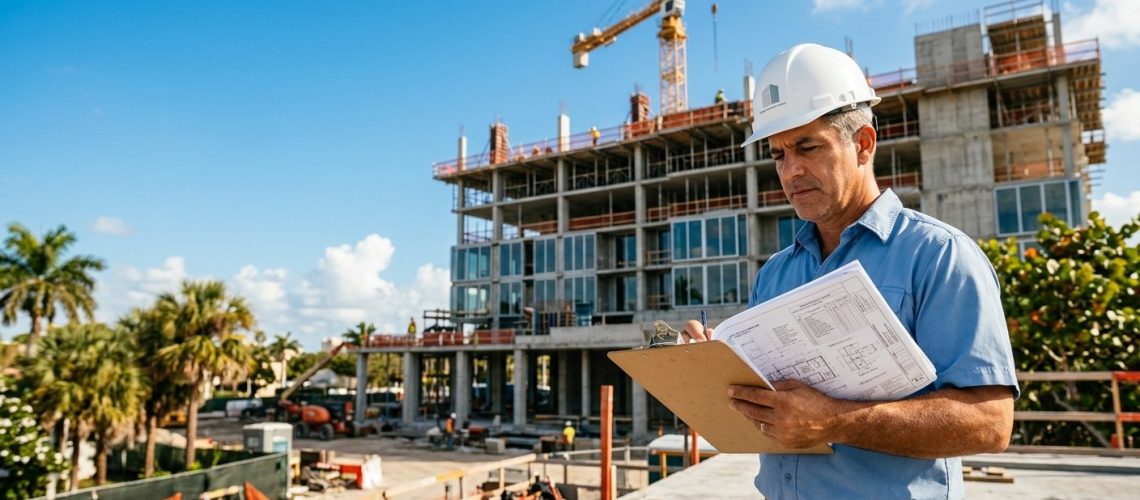
To vet a South Florida general contractor, verify their state license through the Florida Department of Business and Professional Regulation, confirm active insurance coverage, review their portfolio of comparable local projects, and check references from developers or owners they’ve worked with recently. These four steps protect your investment and help you identify a contractor who’s genuinely equipped to deliver in our market.
- Always verify a contractor’s license directly on the DBPR database before signing anything.
- Insurance minimums matter — general liability and workers’ compensation are non-negotiable in Florida.
- South Florida’s permitting environment and building codes are uniquely complex; local experience is a meaningful advantage.
- References from comparable projects (multi-family, mixed-use, hospitality) reveal far more than a polished website.
- A contractor who treats you like a partner, not a transaction, is a better long-term choice than the lowest bidder.
Many developers assume vetting a contractor is straightforward — check a license, get three bids, pick the middle one. But in South Florida’s construction market, where projects in Miami-Dade, Broward, and Palm Beach Counties face layered municipal requirements, hurricane-resistant building standards, and competitive labor conditions, a quick online search won’t protect you. The right contractor is a strategic partner, and choosing one deserves the same due diligence you’d apply to any major business decision.
Start With License Verification — No Exceptions
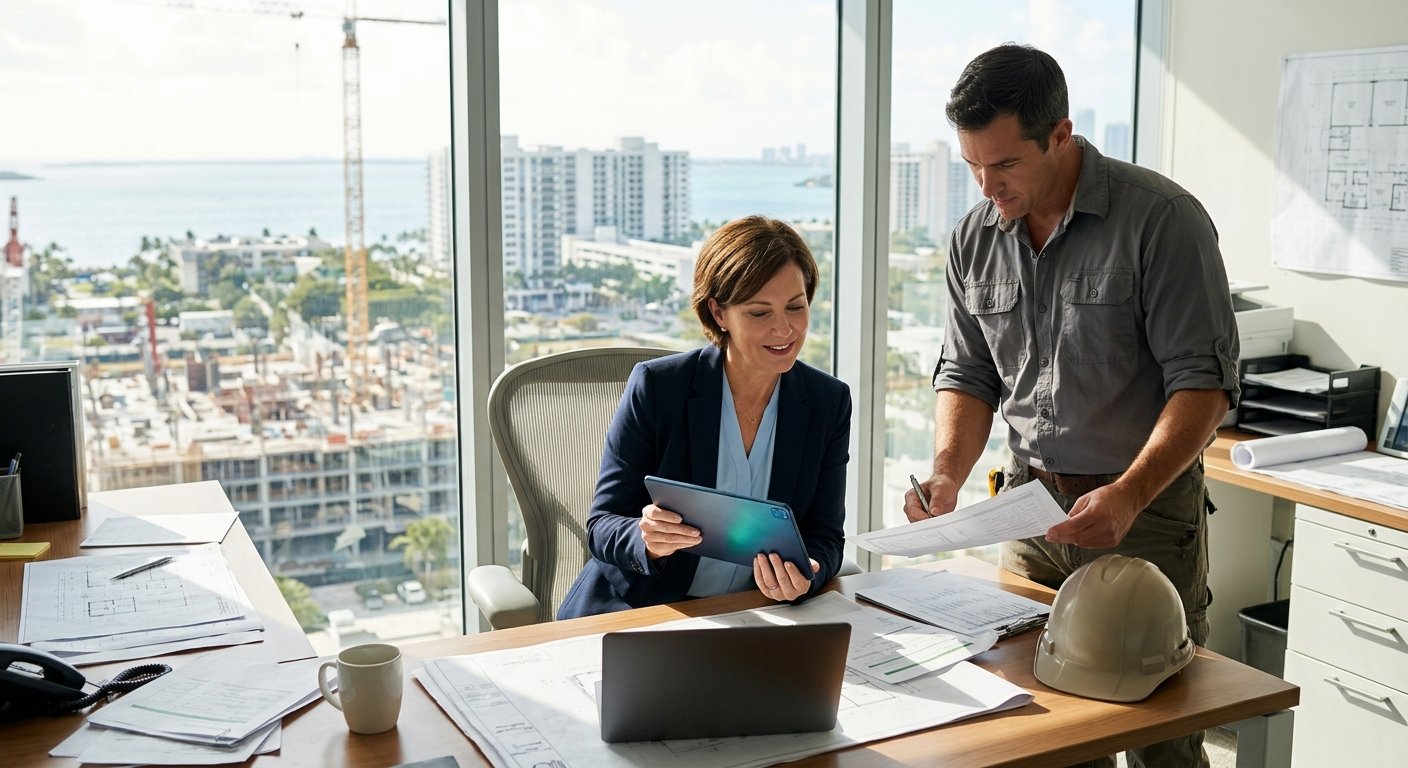
In Florida, general contractors must hold a valid state license issued by the Florida Department of Business and Professional Regulation (DBPR). This isn’t a formality. A licensed contractor has passed examinations, demonstrated financial responsibility, and is subject to oversight that protects you as an owner or developer.
The DBPR’s online database lets you look up any contractor’s license number, verify that it’s current and active, and check for any disciplinary actions or complaints filed against the license holder. Run this check before any serious conversation begins. If a contractor hesitates to provide their license number, that hesitation is your answer.
Beyond the state license, South Florida’s municipalities often require local registration. Miami-Dade and Broward Counties both have their own contractor registration systems layered on top of state licensing. A contractor who is licensed statewide but not locally registered may cause delays the moment permitting begins — and in this market, permit timelines are already tight.
Never accept a photocopy of a license as verification. Pull the record yourself from the DBPR database. License statuses change — a contractor who was licensed last year may have let their certification lapse, and you won’t know unless you check.
Confirm Insurance Coverage in Writing
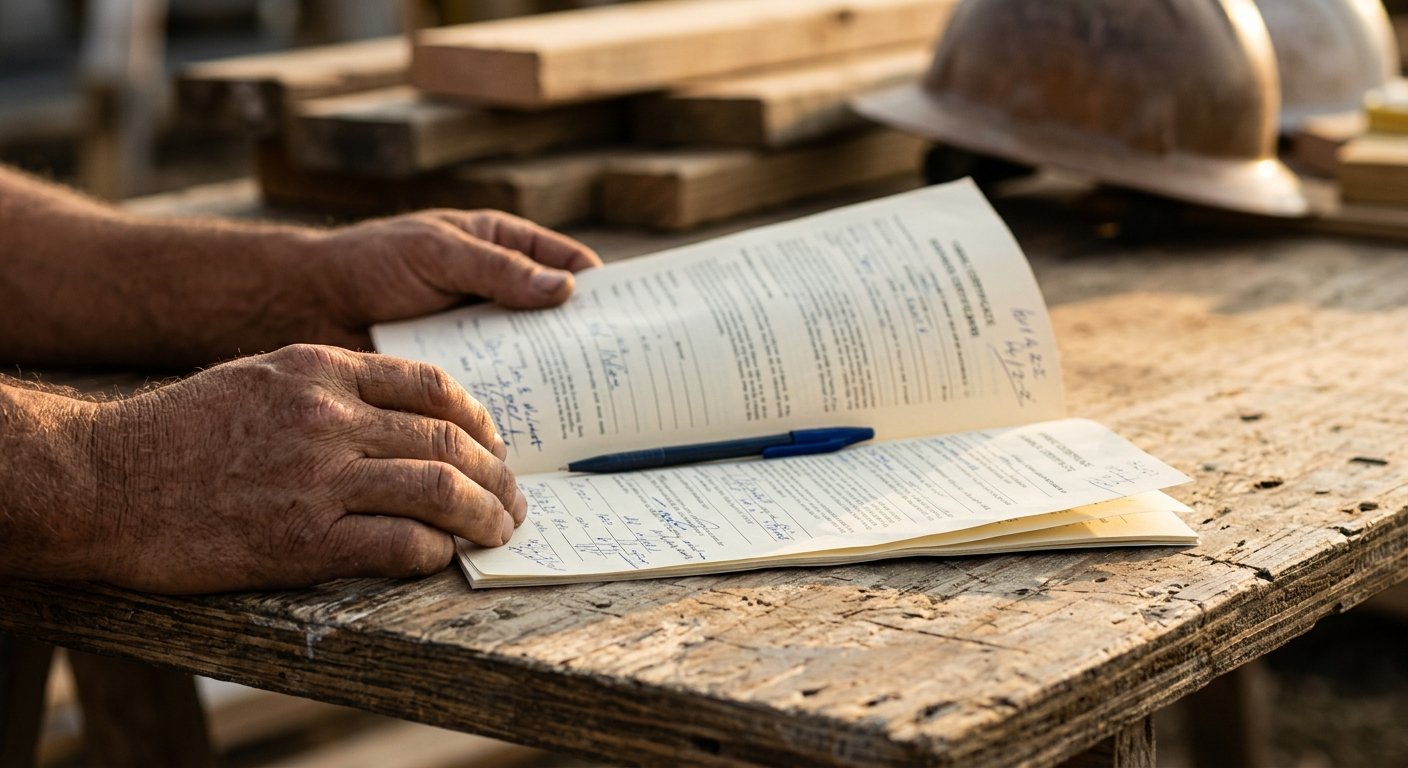
Licensing and insurance go hand in hand, but they’re separate requirements. Ask every contractor candidate to provide certificates of insurance showing two critical policies: general liability coverage and workers’ compensation. Request that you — or your development entity — be listed as an additional insured on the general liability policy for the duration of the project.
Florida law requires workers’ compensation for most construction employers, but coverage limits and exclusions vary. Review the certificate carefully, and if you’re managing a larger commercial development, ask your legal counsel to confirm coverage adequacy before signing a contract. The Florida Division of Workers’ Compensation maintains resources and requirements online that can help you understand what to look for.
An uninsured or underinsured contractor on your site creates liability that flows back to you as the property owner. This is not a place to give anyone the benefit of the doubt.
Evaluate Project History and Local Experience
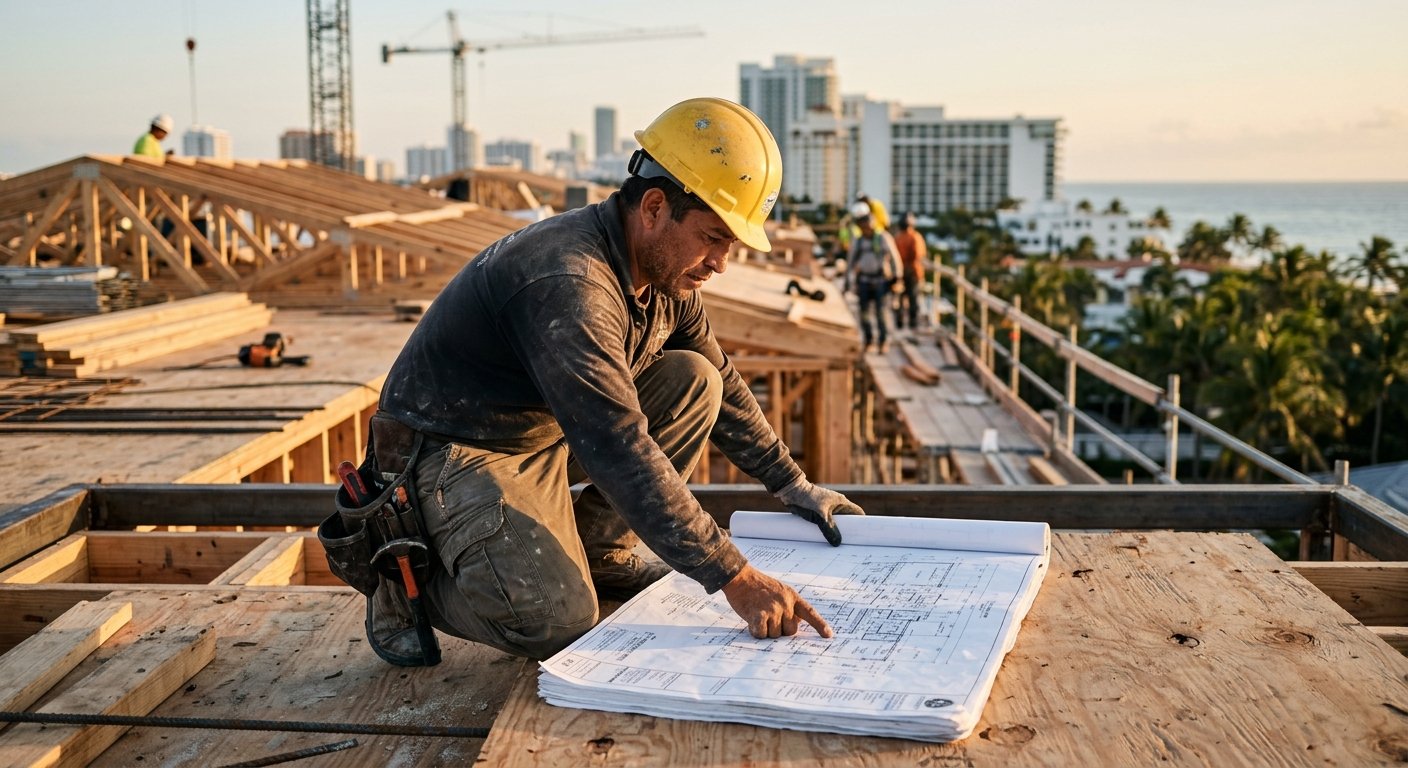
South Florida is not a generic construction market. Projects here must meet Florida Building Code requirements engineered for hurricane exposure, navigate complex coastal permitting, and contend with a labor market and supply chain that has its own rhythms. A contractor who has built extensively in the Midwest or the Northeast is not automatically equipped to manage a mixed-use development in Fort Lauderdale or a hospitality project in Miami Beach.
When reviewing a contractor’s portfolio, focus on comparable scope and geography:
- Have they completed multi-family residential or mixed-use projects in South Florida?
- Do they have hospitality construction experience, or is their portfolio primarily single-category?
- Can they show you completed projects in Miami-Dade, Broward, or Palm Beach Counties specifically?
- How many projects have they delivered in the past three to five years?
At Ortega’s Building & Construction, our work spans multi-family residential development and hospitality construction across the region — and our team brings over 60 years of combined family legacy in South Florida construction to every project. That depth of local knowledge isn’t something you can replicate quickly, and it shows in how we navigate permitting, inspections, and subcontractor relationships.
South Florida’s three-county region isn’t monolithic. Permitting timelines, inspector relationships, and local trade availability differ meaningfully between Miami-Dade, Broward, and Palm Beach Counties. A contractor with deep roots across all three brings a distinct advantage to projects that span the corridor — or when market conditions shift your development plans.
The Vetting Process: Step by Step
Verify License and Local Registration
Search the DBPR database for the contractor’s state license. Confirm active status, no disciplinary history, and local county registration where applicable.
Request and Review Insurance Certificates
Obtain current certificates for general liability and workers’ compensation. Ask to be added as an additional insured before work begins.
Review Comparable Project Portfolio
Ask for a portfolio of completed projects in South Florida that match your project type — multi-family, mixed-use, or hospitality. Look for photos, scope descriptions, and completion dates.
Call References Directly
Contact at least three references — developers, property owners, or architects — from recent projects. Ask about communication, problem-solving, and how the contractor handled unexpected challenges.
Evaluate the Relationship, Not Just the Bid
Meet in person. Assess how the contractor listens, asks questions, and responds to your concerns. The cheapest bid rarely reflects the true cost of a project when relationships and accountability are missing.
What References Should Actually Tell You
A reference list is only valuable if you use it. Most developers call references, ask if the project was completed on time, and move on. Go deeper. Ask the reference about specific challenges — permit delays, material shortages, subcontractor issues — and how the contractor responded. Their answer tells you more than any finished photo.
Ask architects and design professionals on the reference list how the contractor handled RFIs and design clarifications. Ask developers whether the contractor flagged budget concerns proactively or let surprises accumulate. Ask property managers whether the building performs well after handover, and whether punch list items were addressed promptly.
The contractor who communicates clearly when things get difficult is worth more than any contractor who promises things won’t get difficult.
References from multi-family and hospitality projects carry particular weight because those project types involve complex stakeholder coordination, phased construction challenges, and long-term performance expectations that simpler projects don’t demand.
Comparing Contractor Approaches
| Evaluation Criterion | Strong Candidate | Red Flag |
|---|---|---|
| License status | Active, current, no complaints | Expired, suspended, or unavailable |
| Insurance | Full coverage, adds you as insured | Minimal or unverifiable coverage |
| Local portfolio | Comparable South Florida projects | Generic or out-of-market work only |
| References | Direct contacts from recent projects | Reluctance to provide or vague responses |
| Communication style | Proactive, transparent, asks questions | Evasive, promises without substance |
Why the Relationship Matters as Much as the Resume
South Florida’s construction market rewards partnerships built on trust. Projects encounter unexpected conditions — always. What separates great outcomes from troubled ones is whether your contractor approaches problems as a shared challenge or as someone else’s problem to manage. That orientation shows up in the first conversation, not the first crisis.
As a family-owned general contractor and construction management firm, Ortega’s Building & Construction approaches every project with a stakeholder mentality. We serve developers, property owners, and architects across Boca Raton, Miami, Fort Lauderdale, and West Palm Beach — and we’ve built our reputation on relationships that outlast individual projects. Our general contractor services are designed to deliver personal attention alongside professional execution, because we believe the two are inseparable.
When you’re selecting a commercial general contractor in South Florida, ask yourself: does this team feel like a partner? Do they know this market at a granular level? Are they accountable and responsive before the contract is signed? Those qualities don’t change once construction starts.
Frequently Asked Questions
How do I verify a general contractor’s license in Florida?
Visit the Florida Department of Business and Professional Regulation’s online license verification portal and search by the contractor’s name or license number. You can confirm whether the license is active, review its expiration date, and check for any disciplinary actions — all in a few minutes and at no cost.
What insurance should a South Florida general contractor carry?
At minimum, a licensed general contractor in Florida should carry general liability insurance and workers’ compensation coverage. For commercial projects, request certificates of insurance before work begins and ask to be listed as an additional insured on the liability policy. Your legal counsel can advise on appropriate coverage limits for your specific project scope.
Is it important to hire a contractor with specific South Florida experience?
Yes. South Florida’s building codes, hurricane-resistance requirements, permitting processes, and municipal regulations differ significantly from other markets. A contractor with hands-on experience in Miami-Dade, Broward, and Palm Beach Counties will navigate these conditions more efficiently and avoid costly delays that out-of-market contractors often encounter.
What questions should I ask a contractor’s references?
Ask how the contractor handled unexpected problems, whether they communicated proactively about budget or schedule changes, how they coordinated with design teams and subcontractors, and whether they would hire that contractor again. Focus on challenges and responses rather than whether the project was simply “fine.”
What’s the difference between a licensed contractor and a registered contractor in Florida?
In Florida, a certified contractor holds a state-issued license valid statewide, while a registered contractor is licensed through a local jurisdiction and may only work in that area. For commercial and multi-family projects spanning multiple counties in South Florida, a state-certified contractor offers greater flexibility and fewer administrative complications.
Ready to Build With a Team You Can Trust?
Tell us about your project — we’ll show you what a relationship-first approach to South Florida construction looks and feels like from day one.
About Ortega's Building & Construction
Ortega's Building & Construction is a family-oriented general contractor and construction management firm serving South Florida developers, property owners, and architects. Specializing in multi-family residential, mixed-use, and hospitality projects across Miami-Dade, Broward, and Palm Beach Counties, Ortega's emphasizes relationship-building, long-term quality, and a stakeholder mentality. Locally owned and trusted in South Florida for more than 10 years, the company delivers on-time projects with personal attention, integrity, and a commitment to building communities that last for generations. Visit ortegagc.com →